Clangor and languor: Guest maestro Scott Seaton mounts the scaffold at LSO opener
As a firestorm of applause roared through the Wharton Center at the end of the Lansing Symphony Orchestra’s season opener Friday evening (Oct. 2), guest conductor Scott Seaton singled out every section of the orchestra, one by one, for special recognition, leaving nary a bassoon tooter or triangle dinger out.
Cynics say that if everybody’s special, nobody’s special.
As Noël Coward would say, “Balls.” If Friday’s stupendous sounds proved anything, it’s that sometimes everybody can be special, period.
Under Seaton’s nimble, confident leadership, every section was firing on all thrusters. There wasn’t a hint of throat clearing or warming up.
As the first of five finalists for the post of music director to appear this season, Seaton was under a slight handicap. When a competition extends over several months, memories of the earliest concerts can fade. It’s tempting to wonder whether Seaton compensated by making this concert triple-dip memorable. It was a bravura performance, roof-rattling when needed and gorgeous everywhere in between.
The evening’s satisfying musical arc lends itself to the Oreo method of analysis, starting with the crunch of the outer cookies and saving the cream center for last.
In spite of its five-minute length, the evening’s opener, Anna Clyne’s “Masquerade,” was more than a box-checking nod to contemporary music. (Each of the five competing guest conductors are required to include a contemporary work.) “Masquerade” wadded up 35 minutes of music and compressed them into an ultra-dense black hole with an irresistible gravitational pull. Every minute was packed with sudden, did-I-hear-that-or-not quantum events (apologies to MSU physicists for the loose musical usage) and blurry smears of micro-notes the musicians leaned into with scary relish.
There were snippets of melody and lush lyrical moments, but these were perceived only through a kaleidoscope of abstraction and displacement. It felt like riding on the back of a dragonfly as it darted back and forth over a circus, now buzzing the carousel, now racing the horses, now taking a half-second rest on a clown’s nose. It was a wild ride, but it never felt out of control.
The cookie at the bottom end of the Oreo was cut from similar stuff, only on a much bigger scale. In the last two movements of Hector Berlioz’s over-the-top “Symphonie Fantastique,” Seaton again demonstrated his mastery at conjuring split-second, precision madness. The big difference is that nobody ever accused Berlioz of being brief. The nightmarish, opium-induced scenario of a march to the scaffold and descent into Satanic realms serves up one horrific climax after another. Every time things go crashing down, fresh tendrils of madness and obsession curl out of the rubble.
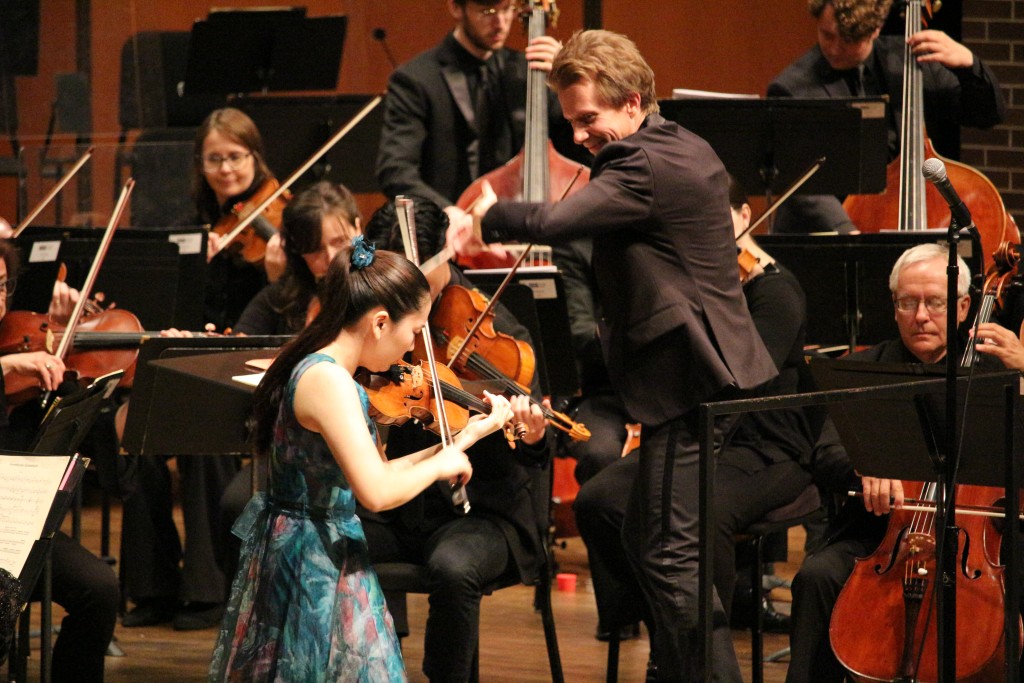
Seaton never grandstanded and made sure it was all about the music, but his inexhaustible bag of cues as he conjured these lurid ceremonies into being made him fascinating to watch. He poked, prodded and twisted every dark detail into the light, folding and unfolding his lithe frame to catch the moment like a mousetrap, with the occasional leap off the podium by way of recoil. A couple of times, he leaned far forward, held his arms about 3 feet off the ground and pulled them back toward his body, as if he were pulling a rug with all 80 musicians sitting on it.
Despite all the percussion (at one point, three timpanists thundered away at once), low brass (including two tubas) and other bells and whistles, Seaton and the orchestra managed to paint plenty of subtle strokes. They etched every voice of the final movement’s fugue with satisfying clarity, then switched to a ghostlike, scratchy tone for the fugue’s second, more unnerving appearance.
That leaves the cream center of the concert. Guest violinist Keila Wakao took the audience into the palm of her hand and revealed the depths of her heart when she joined Seaton and the orchestra for a ravishing performance of Mendelssohn’s violin concerto.
Wakao’s sweet, out-of-this-world tone, especially in the high register, unspooled like a golden thread against a dark and craggy orchestral landscape. There were a few pinfeathers out of place in the virtuosic finale as the orchestra hustled to keep up with Wakao’s quicksilver figures, but the sincerity and energy of the performance never flagged.
Seaton took his time and let the slow movement breathe, the clearest indication that he can handle languor as well as clangor.
The guest maestro demonstrated one more skill Friday. When the 7:30 kickoff time struck, several musicians were delayed in traffic and absent from the stage. Seaton killed the waiting time by informally chatting to the audience about his Michigan roots and the music on the evening’s program. As the latecomers drifted in, one by one, he showed his comfort, and even delight, in connecting with the audience, but as soon as the last straggler took a seat, he wrapped it up and got to work.