Conducting and superconducting as Guest maestro Yue Bao brings clarity, warmth to LSO
Some sticks in the mud still insist it’s uncool to applaud between movements of a major orchestral work, but that’s not how we roll in Lansing. Whether it’s Tchaikovsky or chip dip, if we love something, we let ‘er rip and let the chips fall where they may.
Guest conductor Yue Bao and pianist Ying Li found that reflex at Friday’s (Oct. 16) Lansing Symphony Orchestra concert and showed no mercy in hammering it. Their glittering, thundering, soaring carpet ride through the first movement of Tchaikovsky’s First Piano Concerto provoked not just applause but a standing ovation, smack dab in the middle of the musical freeway.
And why not? We are Lanstronauts. If you prick us, do we not bleed? If you wow us, do we not say, “Wow?”
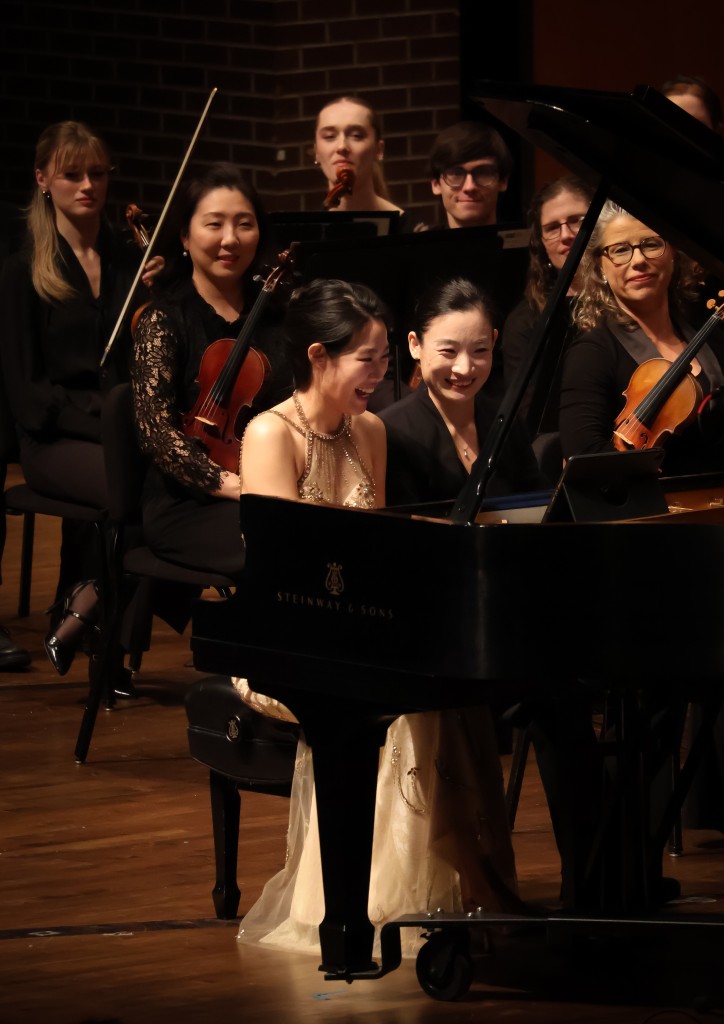
Bao, Li and the orchestra spun like a top through Tchaikovsky’s beloved concerto, combining crystal clarity with steamroller momentum and, best of all, palpable warmth. In the slow movement, Li pivoted from torrents of tumbling arpeggios to spellbinding semi-silences that held every second in sweet suspension. (A piano teacher friend informed me after the concert that Li didn’t miss a single note, either. I had to take her word for it, because many of her sprints left my turtle-like ears in the dust.)
The woodwinds extruded gossamer threads of gorgeous melody, exhibiting flawless solo and ensemble work. By the time the finale rolled around, everyone was deep in the zone, and the synchronization between pianist and orchestra was so tight you couldn’t fit a bristle of Tchaikovsky’s beard between them.
A standing ovation between movements wasn’t the only first Bao and Li brought to the evening. After the concerto, conductor and pianist crowded onto the piano bench and teamed up for a rip-roaring four-hand piano version of Leonard Bernstein’s effervescent “Candide” overture. They dove into it a bit prematurely, got mixed up and had to start over again, but the false start only made the encore more charming, as if we were all in Bao’s living room having a swinging soiree.
Friday’s concert opened with another first: the U.S. premiere of Michigan State University composer Zhou Tian’s aptly named “Threads,” a zesty whirlwind of orchestral colors and textures that showcased Bao’s skill at infiltrating the music and teasing out every thread.
The bad news is that it’s time to panic a little bit. This business of picking a new music director for the orchestra isn’t going to be easy. Bao brought something ineffably fresh to the hall, a deep-breathing, positive vibe that’s hard to pin down but no less real. The paradox is that she did it almost totally through music making, without talking to the audience or grandstanding on the podium. She flashed the occasional smile when Li turned a nice phrase on the piano or a section of the orchestra swooped in with extra panache, but she didn’t go in for expressive, extroverted gestures.
From the back, she resembled a water strider on a swiftly moving stream, her arms and torso constantly in motion, suspended on the musical meniscus by sheer surface tension. She was not so much conducting as superconducting — in the material physics, not the comic book, sense of the word. The music flowed on irresistibly, with zero friction and maximum energy efficiency.
But this was no chilly display of virtuosity, either. Somehow, Bao conjured an atmosphere of generous, heartfelt warmth without indulging in the huffing and puffing and sweating that go along with the clichéd public image of your average maestro.
After the crowd-pleasing highs of Tchaikovsky, Bao set herself a tougher test. Although Dvorak’s Seventh Symphony is highly regarded by the cognoscenti, it lacks the sonic bells and whistles and melodic hooks that get people to their feet. It’s as if Bao dared to enter the “Great British Bake Off” with an offering of basic black Russian bread.
But if the bread is satisfying enough, you don’t need anything else. The orchestra plunged into the composer’s molasses-dark moods and bittersweet reflections with total commitment. Every fresh challenge was met with aplomb, if not relish. Do you need all 50 string players to spiral up the scale an entire octave, in total sync, and land together on a drifting mote of dust? Can do. Do you need the last note of the slow movement to sound exactly like a deep breath? No problem. Do you need the horn section to embody the slanting rays of a setting sun? Got that.
Bao took extra care to let the music breathe. She massaged every last bit of emotion out of the meditative passages when the music gradually winds down, from the cloudy crags to the cozy foothills. You could almost see the lights coming on in the village below. That’s when you glanced backward and realized you just climbed a very big mountain.