
David Campbell Hill returns from nearly five-decade hiatus with first solo novel
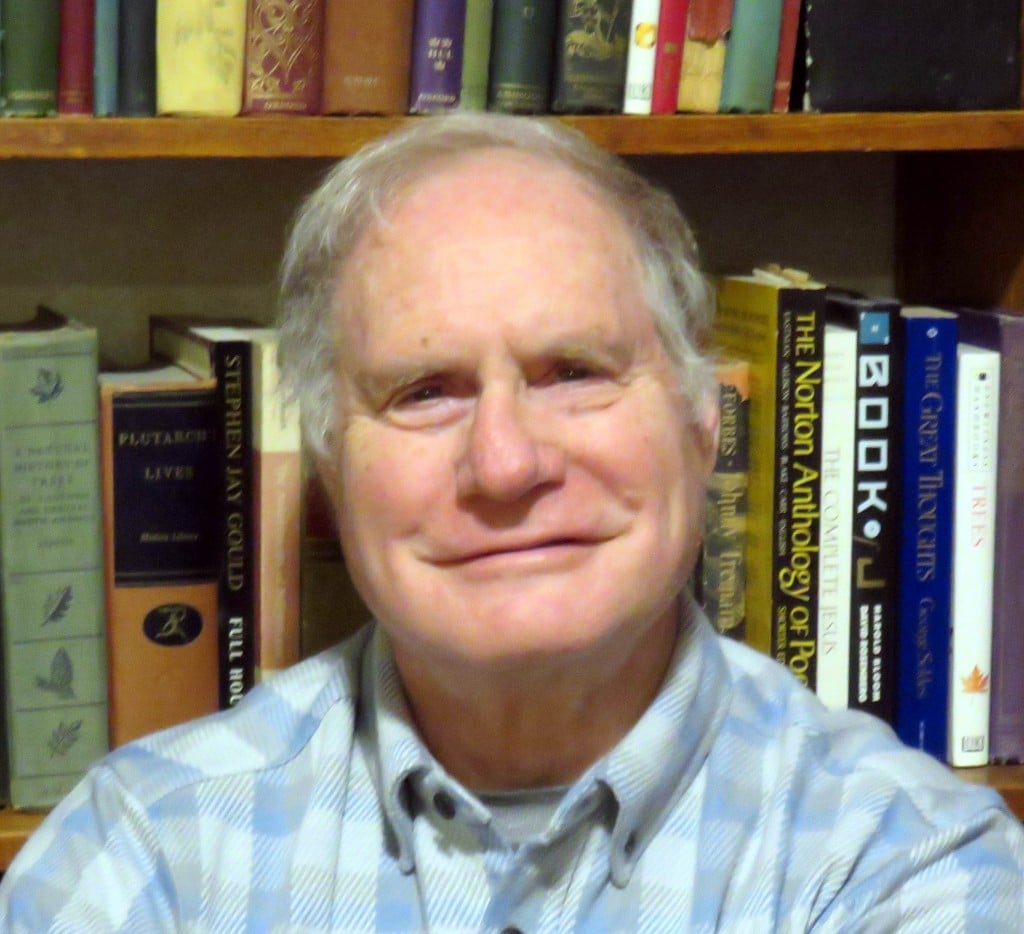
There was a 46-year gap between Lansing author David Campbell Hill’s last novel, 1980’s “Invader,” and his latest novel, “Pandora’s Daughter” (Sunacumen Press, $24.95).
“The number of years between books astonishes me,” said Hill, 75, who co-authored “Invader” with his late father, Albert Fay Hill. “I did write a screenplay with my father and a novel on my own in the early 1980s, but at that point, it was clear I wasn’t going to get rich any time soon. Our agent was not interested in my solo book.
“I started looking for real work,” he continued. “I never really stopped writing, but it was piecemeal and competed with a full-time job, another career change and getting married twice, not to mention 10 years in skydiving. The publishing market changed tremendously. I sent manuscripts out every now and then but couldn’t attract much interest.”
He began “Pandora’s Daughter” in 2004. He retired in 2018, which freed up a lot of time.
“I promised myself I would get back to writing and would show that I could complete novels without my father’s help,” he said. “I went to workshops, joined a couple of writing groups, got on the board of A Rally of Writers, cleaned up my old solo novel, finished ‘Pandora’s Daughter’ and started an entirely new book.”
He spoke about the impetus to write “Pandora’s Daughter.”
“After being stuck for a long time, I decided to give up on the idea of writing a bestseller and just write something that was fun,” he said. “Since I like history, geopolitics and physics, all I needed was an idea. That came when I read about the almost certainly apocryphal ‘Philadelphia Experiment.’ It doesn’t appear in the book at all, but it led to a chain of ideas that (became) ‘Pandora’s Daughter.’”
In the book, barbarism and chaos run rampant throughout the galaxy. In the midst of it, a dying empire searches for an ancient fount of knowledge that holds the key to humanity’s perseverance.
Emperor Stuart II fears that his empire, which has kept order for millennia, will collapse after his death. His daughter, Fuji, embarks on a six-month voyage into the decaying and lost realms of the empire in search of the wisdom that will hold it together. Aboard a powerful warship, the princess confronts an alien species that has taken a keen interest in her search for the lost planet that might harbor all the answers: Earth.
“Emperor Stuart II is directly inspired by the Roman emperor Marcus Aurelius and his despicable son Commodus,” Hill said. “Fuji was supposed to be a love interest, not the main character. After all, I am a guy, and I wasn’t sure I could get inside a female character’s head. But as I continued writing, she took over the story, and my original protagonist fell into the role of love interest. I decided to go with it.”
Hill self-published “Pandora’s Daughter” instead of having it traditionally published like he did with “Invader” and 1976’s “The Deadly Messiah” (which he also co-authored with his father).
“I contacted over 100 agents and got a few nibbles, but nothing developed,” he said. “I had hoped that my publishing history might get me an ‘in,’ especially since one agent said he had worked for the publisher of ‘Invader’ and offered to read it, but I never heard from him again. I talked with many other writers and found agreement that self-publishing was the new normal. I had help from people who had already done it, which showed me a path forward.”
The author discussed how the publishing industry has changed in the 46 years between novels.
“It’s become bigger, faster, more commercial. There’s less interest in non-established authors,” he said. “I found a lot of agents wanted writing by traditionally oppressed groups. I used to send out manuscripts with stamped, self-addressed envelopes. Now it’s all done online, which is kind of cool, actually.”
Major influences on Hill’s work include his interest in physics and history, particularly the Roman Empire, as well as “Star Trek: The Original Series” and the works of noted science-fiction authors Isaac Asimov, Arthur C. Clarke, Robert A. Heinlein and Larry Niven.
His father was also a crucial influence.
“He gave me the discipline to develop an entire story, then stick to the process of writing it. He also had contacts that helped get our two books traditionally published. We had long sessions firing ideas at each other. One of us would write a chapter, then the other would edit it, then we would pass it back and forth,” Hill explained. “My stepmom also did a lot of editing, which evened out our writing styles. Note to other potential father-son writing teams: It can be embarrassing writing sex scenes with your father. I also deduced a lot about my parents’ history from working with them. Sometimes, it’s definitely TMI!”
Origin of “The North Avenue Irregulars”
A World War II veteran and Purple Heart recipient, Albert Fay Hill was a pastor in New Rochelle, New York. During his time as senior pastor at North Avenue Presbyterian Church, Hill led the fight against organized crime, which had taken over the suburb. After local gangsters brutally murdered a young man for failing to pay his gambling debts, Hill began his own inquiries into the influence of organized crime and formulated a plan for reclaiming the community.
When his efforts spread, he was contacted by U.S. Treasury agents. He agreed to form a citizen’s task force, but he encountered reluctance from his male parishioners to volunteer. However, when he approached women in the congregation, they enthusiastically agreed. Using the information gleaned from the women, Treasury agents organized raids on a number of gambling houses. Word of the team’s success spread, and one of the larger raids was featured on the front page of The New York Times. Look magazine followed up with an article on Hill and his task force.
Soon thereafter, Cowles Publishing approached him about writing a book. In 1968, “The North Avenue Irregulars” was released. Walt Disney Productions purchased the movie rights, and in 1979, the film adaptation was released, starring Edward Herrmann (“Gilmore Girls”) and Cloris Leachman (“The Last Picture Show”).
SOURCE: David Campbell Hill and IMDb.
Hill and his father spoke about collaborating after Hill graduated from Northwestern University.
“We discussed the unfortunate fact that we lacked abundant income,” Hill said. “My father had earned some money writing a book about his adventures fighting organized crime in New Rochelle, New York, called ‘The North Avenue Irregulars,’ so we thought that might work. We sketched out a plot before we got home, which turned into ‘The Deadly Messiah’ in 1976 and ‘Invader’ in 1980. I also remember hunt-and-peck writing on my parents’ old manual typewriter many years before that. I wish I still had some of that stuff. In those days, I couldn’t put together a plot or stick with it, but I had an active imagination.”
Hill and his father aren’t the only writers in the family.
“Friends get cross-eyed listening to conversations around the dinner table. Everybody reads,” Hill said. “My sister writes poetry and helped her daughter write her doctoral thesis. My brother is a published author and poet. My father published two more books after we stopped working together, and I have manuscripts for four other novels he wrote but never published. Plus, he published a medical study on his work with cancer immunology. My stepmom’s ideal day was sitting on a chaise lounge in the backyard,
editing our work. My brother married a college professor who has her books in the Harvard Library. My brother-in-law has a book on golfing.”
Hill’s writing has come a long way since “The Deadly Messiah.”
“When our first book came out, I had delusions of being some sort of wunderkind. I got cured of that pretty quick. It’s been a long process of doing the work to learn the craft since then” he said. “I’ve had fantasies of rewriting the books I wrote with my dad or even the books he wrote himself. I think I could make them a lot better.”
For Hill, writing is like meditating.
“You get in a zone,” he said. “Everybody needs to create something.”
Related Articles


‘All will be revealed’: rock legend Alice Cooper releases memoir
In his new memoir, “Devil On My Shoulder” (Da Capo, $32.50), Detroit native Alice Cooper details his “evilution.”