
Willie Johnson finds catharsis in revisiting past traumas
Military veteran Willie Johnson didn’t want his children to guess who he was or why he was the way he was.
That’s one of the reasons he wrote “I Was There: Echoes of a Broken Boy.” Johnson published the memoir through LivOutUrDream LLC, a creative brand he founded in late 2025 dedicated to storytelling, music and personal transformation.

“Writing gives them something they can come back to. It gives our family a record beyond the things we happened to talk about,” Johnson said. “And for somebody outside my family, I hope the book says this: You can be carrying a lot and still have something to give. I was there. I am here. And I’m still working on what comes next.”
The impetus to write “I Was There” came while attending grief counseling after the death of his father. However, he explained that there was so much more connected to it. He felt like he needed to go back to the beginning.
“I started putting down what I remembered,” he said. “I used conversations with ChatGPT to help unpack the memories and organize them into chapters, and I asked family members questions as things came back to me. I also wanted to look back and ask where God had been through all of it. What started as trying to understand my own life became ‘I Was There.’”
More about Willie Johnson
Born and raised in Washington, D.C., Willie Johnson is the second of four children. He lives in Lansing with his wife of nine years. The couple has five children, ages 20, 19, 16, 8 and 7.
Johnson is a graduate of Dunbar High School, where he participated in JROTC and the armed drill team. He completed some coursework at Prince George’s Community College in Largo, Maryland.
From 2005 to 2009, he served in the D.C. National Guard. He started as a motor transport operator and later worked as an automated logistical specialist. His service included Hurricane Katrina relief and deployment to Iraq. His final rank was specialist (E-4), and his discharge from the military was general under honorable conditions.
“JROTC gave me structure and a sense of belonging,” he said. “When I joined the D.C. National Guard, I saw a way to serve my country, learn a practical skill and still help my family. My grandmother depended on me, so those responsibilities were part of the decision.”
A Washington, D.C., native, Johnson grew up around addiction, incarceration, violence and loss.
“My mother was shot while she was pregnant with me, so the story begins before I could even remember it,” he said. “Later, I lost her while I was still a child. My father was incarcerated during parts of my childhood, and my grandparents stepped in to raise us. There was love in that home, but there was also grief I didn’t know how to handle. I dealt with bullying and fighting, and I learned to put a hard face on things. As a boy, I didn’t have the words to explain what I was carrying. A lot of that pain came out as anger.”
Admittedly, he is still working through a lot.
“I can get up, take care of people and look like I have everything together while there is still a lot happening inside. That’s something I’ve had to be honest about,” he said. “My faith, my wife and children, counseling and writing have all been part of that work. The military taught me discipline, but I also had to learn that being able to keep going doesn’t mean I’ve dealt with everything. Asking for help and looking at those memories gave me a way to start understanding them.”
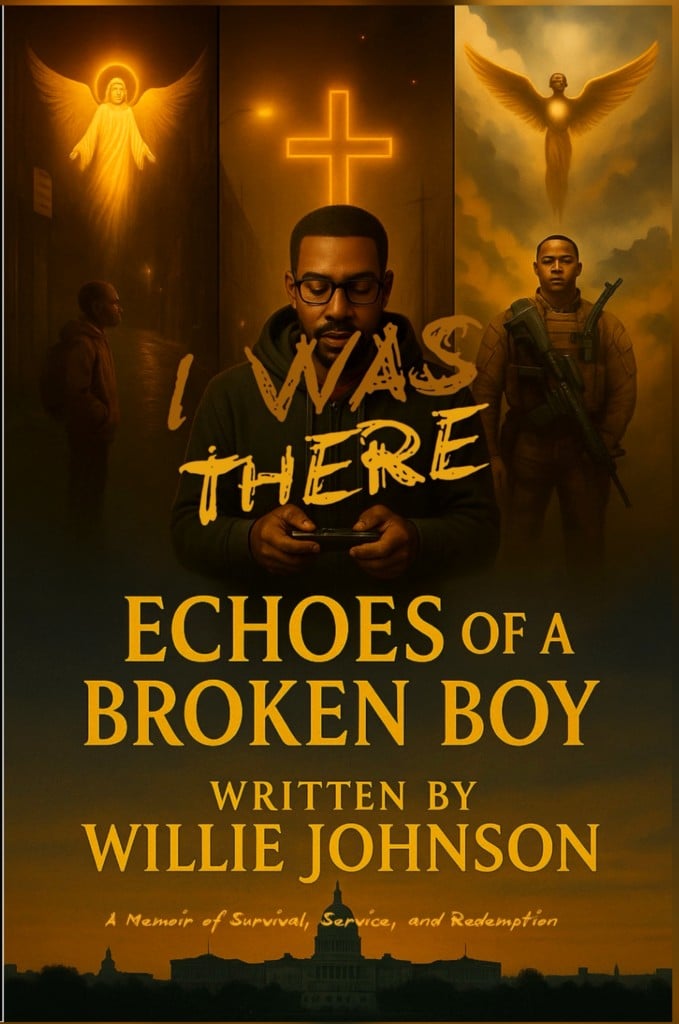
Writing “I Was There” was cathartic. At the same time, it was also difficult.
“Writing brought back things I hadn’t thought about in years and some things I didn’t remember until I started talking. There were moments when I had to stop,” Johnson explained. “Writing about my brother’s death was one of the hardest parts. I got to that chapter and struggled to move forward. There’s a difference between knowing something happened and sitting down long enough to put it into words.
“I also had to think about the people who are still here,” he continued. “This is my experience, but other people lived parts of it with me. I wanted to be honest without being careless with them.”
He was especially worried about hurting his beloved grandmother.
“But she read the finished book — I think she read it four times — and our relationship grew stronger. That meant a lot to me,” he said.
Writing the memoir helped him connect parts of his life that he’d been carrying separately.
“I could see how that little boy’s grief followed me into being a soldier, a husband and a father,” he said. “It follows the connections between childhood in D.C., military service, family, grief and faith. You see the boy before you see the soldier, and you see how what happened to him affected the man he became. I wanted to be honest about the parts that are hard to say out loud. I’m still learning, and that’s in the story, too. Putting it into words didn’t erase what happened, but it helped me understand myself. I hope someone reading it can recognize something of themselves and feel that their own story matters.”
He spoke about founding LivOutUrDream.
“A friend of mine used the phrase ‘live out your dream loud,’ and it stayed with me. I know what it feels like to have ideas and experiences inside you without knowing how to bring them out. Learning to publish my own story showed me that I could help someone else do it, too,” he said. “LOUD brings together storytelling, publishing, music and family creativity. I’ve helped with my son’s comic and a fellow veteran’s cookbook. I want people to see that their stories and their ideas are worth doing something with. For me, that’s part of building a legacy.”
Johnson is working on his second memoir, “I Am Here,” which chronicles his family’s move to Michigan. He is also adapting “I Was There” into a graphic novel. In the long run, he wants to turn the memoir interview process into a workbook or a class that helps people explore their lives and preserve their family histories.
“Through LOUD, I want to keep helping other people bring their work into the world,” he said.
He gave some advice to people who have endured great trauma and hardship and want to write about it.
“Start with what you can say. You don’t have to explain your whole life at once,” he said. “Talk to someone you trust, ask for help, or write something down if that’s where you can begin. I know what it is to put the face back on and go take care of the next person. But you need care, too. Give yourself room to get it. Your story matters — even the parts you haven’t figured out how to tell yet.”
Related Articles

‘All will be revealed’: rock legend Alice Cooper releases memoir
In his new memoir, “Devil On My Shoulder” (Da Capo, $32.50), Detroit native Alice Cooper details his “evilution.”