Lansing can do better than a tent in a park
Fifteen years ago, then-Mayor Virg Bernero wrapped himself in the “Occupy Wall Street” movement by allowing protesters to “occupy Lansing” by sleeping overnight at Reutter Park, across Capitol Avenue from the library.
Bernero, coming off an unsuccessful gubernatorial run, saw political mileage in latching onto a national movement about financial inequality. The “1%” own everything and the rest of us, the “99%” are doing our best to make do the best we can.

From October and into the winter, Bernero let protesters slowly turn Reutter Park into a collection of tents and tarps that looked more like a homeless encampment than an organized protest.
Ultimately, the unsightly health and fire hazard got too much. The liability of passively letting someone potentially freeze to death by sleeping under the stars in a Lansing park drove Bernero to end the continuous sleepovers.
By early December, the city had spent $20,000 over the two months of “occupation” to provide sanitation, trash pickup and public services to the park.
Fast-forward to last year when Judge Rosemarie Aquilina toured the largest homeless encampment I’ve ever seen, behind Piazzano’s restaurant off Grand River Avenue. The judge spent more than an hour talking to residents, several of whom had been living in the woods beside the Grand River for more than two years.
Appalled by it all, the judge ordered the city to move the people to what ended up being the Causeway Bay hotel. From there, many of them were offered services and a road to self-sufficiency.
When I poked my head into this old property two weeks ago, it appeared the encampment had been long abandoned.
And finally, it’s only been a few months since the most recent person had their face smashed in, potentially from a serial killer police suspect may be targeting unhoused men in the middle of the night. As a frequent River Trail user myself, I haven’t seen a collection of homeless people living along the trail in months.
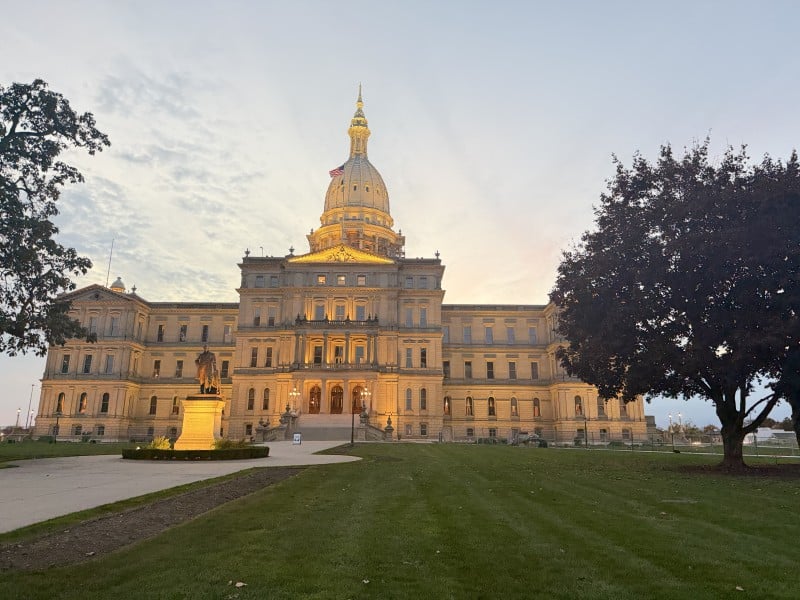
With these past events as a backdrop, it’s not hard to see why Lansing City Councilmember Deyanira Nevarez Martinez’s recent proposal to open select city parks from dusk to dawn for 60 days isn’t the solution.
There’s the cost, the community aesthetics, the lack of facilities, the threat of open fires – all of the same issues that came with the “Occupy” encampments.
Wrapping our arms around finding acceptable places for people to sleep outdoors in the winter, by extension, means we find it acceptable that people sleep outdoors in the winter. Judge Aquilina reminded us all last year that it was not.
And let’s not forget, WE STILL HAVEN’T FOUND THE SERIAL KILLER OF HOMELESS MEN! Is it a stretch to think this person would find a way into one of these proposed parks, nearly all of which are in neighborhoods?
Opening parks to camping, for any length of time, is a hard no.
What her proposal does is spur city leaders, and really all of us, into action.
It forces us to find and fund solutions that appeal to our humanity and sense of decency. Clearly, the city can be prodded into action when forced, as Judge Aquilina proved.
The solution isn’t a winter encampment at Willoughby Park or on the River Trail underneath the Kalamazoo Street Bridge.
It starts with a plan crafted by experts on how to transition the unhoused to more stable accommodations. Can we get a rough count of Lansing’s homeless population? Where are there available beds? Heated indoor accommodations with facilities? Are there enough service providers to pull it off?
From there, city leaders need to put their stamp on it, city workers to make it happen, and for all of us to be fine paying for the solution with our tax dollars.
Of course, we’re not the only community with a homeless population. Some may be concerned that any services we provide will draw more unhoused people to our community. The more we provide, the more folks will take advantage of the services.
That’s one way to look at it.
Another way is that by showing the rest of Michigan a model policy that’s funded by the public, other communities will have the courage to follow suit.