Michigan Proposal 1 and Proposal 2
Michigan Proposal 1, Constitutional Convention Question
Proposal 1 is an automatic ballot-referral question, meaning it appears on the ballot at certain intervals or under certain circumstances. The official ballot title is “Shall a convention of elected delegates be convened in 2027 to draft a general revision of the State Constitution for presentation to the state’s voters for their approval or rejection?”
Because of the measure’s status as an automatic ballot-referral question, there is no custom ballot text.
During a constitutional convention, delegates propose amendments and changes to the state constitution. Michigan is one of the states with a process to decide whether to hold a constitutional convention and automatically puts it on the ballot.
A question about whether to hold a state constitutional convention, called a “Con-Con,” is put on the ballot every 16 years, starting in 1978, according to Section 3 of Article XII of the Michigan Constitution. Michigan is among 14 other states with a similar process. In 1960, voters approved the measure through Proposal 3.
Michigan’s last constitution was approved in 1963, making November’s question the state’s longest run without calling a convention.
A strong majority of voters defeated the measure the last three times the question appeared on the ballot in 2010, 1994 and 1978.
If the measure passes, the convention would meet in October 2027. There is no limit on how long the convention would last.
House Speaker Matt Hall (R-Richland Township) and Senate Minority Leader Aric Nesbitt (R-Porter Township) told Michigan Advance last May that they support a convention to rewrite the state’s constitution.
Opponents include United Auto Workers (UAW), the Lansing Regional Chamber of Commerce and the Michigan Education Association (MEA).
UAW said in a statement that voting “No” on Proposal 1 would protect the constitution from corporate and billionaire influence.
In a social media post, the Lansing Regional Chamber of Commerce said opening up an opportunity to revise the constitution “would create significant uncertainty” when the state should be focused on economic growth.
The MEA is urging voters to reject the proposal. The organization said it would make the constitution vulnerable and allow “anti-public school advocates to privatise schools, open the floodgates for vouchers, and enact anti-union policies statewide.”
Earlier this month, Right to Life of Michigan, a prominent anti-abortion group, joined the list of organizations against the measure.
“While we recognize and applaud the ongoing debate around this issue, RLM is opposed to opening the state constitution to a convention at this time,” Right to Life of Michigan President Amber Roseboom said in a statement. “Moreover, even if a Constitutional Convention were to be called through passage of the question this year, any recommended changes from the delegates would go before the citizens for a popular vote before being ratified. The citizens of our state continue to hold the power. Anyone suggesting otherwise is either misinformed or being intentionally dishonest with voters.”
Michigan Proposal 2, Campaign contribution limits
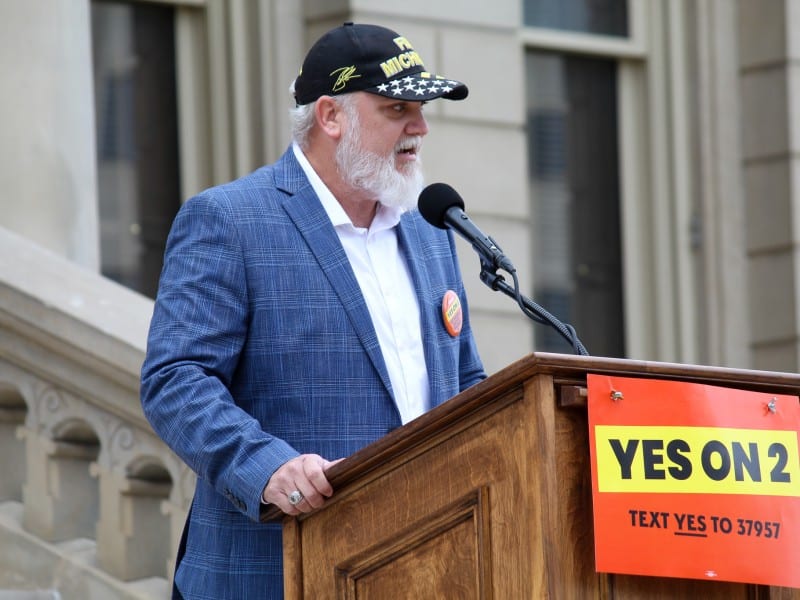
The citizen-initiated ballot measure known as the Michigan Utility and Government Contractor Campaign Finance Regulations Initiative is on the ballot in an attempt to regulate campaign finance contributions.
The ballot proposal is in the hands of voters after Senate Majority Leader and current Democratic nominee for Lieutenant Governor Winnie Brinks (D-Grand Rapids) told The Detroit Free Press in August that lawmakers will not vote on a version of the proposal.
Michiganders for Money out of Politics is the coalition sponsoring the measure and includes organizations like Clean Water Action, Michigan League of Conservation Voters and Voters Not Politicians.
Supporting officials include Rep. Donovan McKinney (D-Detroit), current Lieutenant Governor Garlin Gilchrist and Secretary of State and Democratic gubernatorial nominee Jocelyn Benson.
Michigan’s U.S. Senate Democratic candidate Abdul El-Sayed also supports the measure and has made “Money Out of Politics” a campaign priority.
Protect MI Free Speech leads the campaign against the proposal. Organizations including Blue Cross Blue Shield of Michigan PAC and the Michigan Chamber of Commerce also oppose the initiative.
Analysis from the Energy and Policy Institute found that Consumers Energy’s parent company contributed $15,000 to Protect MI Free Speech. Another $15,000 was donated by Blue Cross Blue Shield of Michigan. If the proposal wins the majority vote, both groups will be prohibited from making campaign contributions.
The review also reported that 82% of current state legislators have received utility PAC money. Gov. Gretchen Whitmer is at the top. She nominates the regulators who manage Michigan utilities. Regulators determine rate increases and profit margins.
Republican Senate Minority Leader Aric Nesbitt, a previous gubernatorial hopeful, falls just behind Whitmer, according to the review.
A “yes” vote supports prohibiting certain organizations and individuals, like those outlined in the proposal’s text, from making direct or indirect contributions to those who run for office. A “yes” vote also supports further regulations for campaign finance laws and spending on political communications.
A “no” vote rejects the proposal.
Text of the ballot proposals
State
Proposal 2026-1 A proposal to convene a constitutional convention for the purpose of drafting a general revision of the state constitution
Shall a convention of elected delegates be convened in 2027 to draft a general revision of the State Constitution for presentation to the state’s voters for their approval or rejection?
Proposal 2026-2 A proposed initiated law to prohibit campaign contributions from certain regulated utilities and government contractors and apply campaign finance laws and regulations to additional types of political communications
The proposal would:
• Prohibit regulated electric and gas utilities, contractors with over $250,000 annually in government contracts, and people and organizations with substantial connections to these utilities/contractors from making direct or indirect campaign contributions to those who run for or hold offices that impact them.
• Expand laws regulating spending on political communications, including those requiring disclosing donor information, to apply to communications clearly identifying candidates or ballot questions, even if they do not expressly advocate voting for/against them.
• Expressly apply the law requiring disclosure of who paid for political communications to internet political communications.
Should this proposal be adopted?
City
CITY OF LANSING ESSENTIAL SERVICES MILLAGE RESTORATION PROPOSAL
For the purpose of funding essential services, including police protection, fire protection, and local road and sidewalk maintenance, shall the authorized charter millage for the City of Lansing, established at 20 mills ($20.00 per 1,000 of taxable value) and reduced to 19.2214 (19.2214 per 1,000 of taxable value) by the millage rollbacks required under the Michigan Constitution,be restored to 20mills (20.00 per 1,000 of taxable value),which is an increase of.7786 mills (.7786 per $1,000 of taxable value) over the reduced millage, for the next five (5) years (from January 1, 2027 through December 31, 2031 inclusive)?
If approved and levied in full, this renewed millage restoration would generate approximately $2,585,101 in its first year.
CITY OF LANSING CITIZENS’ ADVISORY HEALTHCARE ACTION BOARD CHARTER AMENDMENT
Shall the Lansing City Charter be amended to mandate the creation of a Citizens’ Advisory Healthcare Action Board (“Citizens’ Action Board”) to create a Lansing Healthcare Action Plan and make recommendations to the community to address healthcare costs and healthcare inaccessibility; to prescribe the powers and duties of the Citizens’ Action Board; to prescribe the Citizens’ Action Board’s composition and organization; and to require the publication, a public overview, and recommendations for implementation in the community of the Healthcare Action Plan?