Over the moon
Seconds after Lansing Mayor Andy Schor cut the ribbon Tuesday morning (Sept. 16) on the Historical Society of Greater Lansing’s first-ever permanent home, the historic Rogers-Carrier House on …
Historical Society of Greater Lansing finds a dream gingerbread house
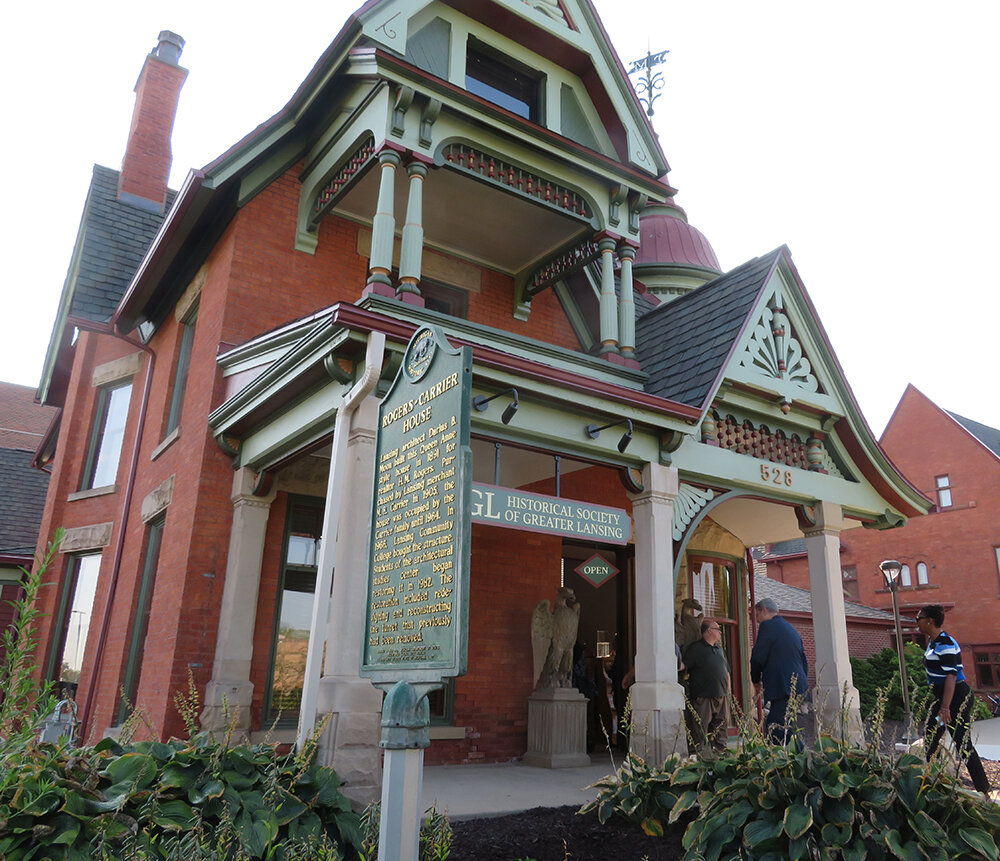
Seconds after Lansing Mayor Andy Schor cut the ribbon Tuesday morning (Sept. 16) on the Historical Society of Greater Lansing’s first-ever permanent home, the historic Rogers-Carrier House on Capitol Avenue, the ribbon was carefully curled in the hand of the organization’s proud president, Bill Castanier.
“It’s part of the collection now,” he said with a grin. “It’s part of history.”
For all its well-attended events, award-winning projects and tens of thousands of followers on social media, a permanent home has eluded the Historical Society since it was founded in 1955.
Before Tuesday, Lansing was the only capital city in the nation without a permanent museum or learning center solely devoted to local history, according to Castanier.
The green gables and gingerbread-like Queen Anne stickwork of the Rogers-Carrier House will provide a perfect setting for the group’s many activities — “just what you would want for a historical society,” Schor said at the ribbon cutting.
The Historical Society has been talking with the house’s owner, Lansing Community College, for years about using the space, but LCC President Steve Robinson said it took longer than expected to refurbish the gorgeous 1891 edifice, designed by Lansing architect Darius Moon.
Moon, a self-taught architectural genius, designed many landmark buildings in mid-Michigan, including the Turner-Dodge House and the looming R.E. Olds residence, demolished in 1971, but the Rogers-Carrier House is among the most spectacular examples of his epic whimsy.
Lansing Community College bought the house in 1966. It’s been used as a bookstore and an office space over the years, but Robinson said it has “no real college use right now.”
In the 1980s, LCC welding students and faculty built a new “witch’s hat” turret to replace the original one, which had been demolished for scrap by the previous owners. Since 2022, the college has invested more than $600,000 in exterior and interior work to bring the building to modern standards.
In exchange for use of the space, the Historical Society has agreed to work with LCC on local history classes and serve as a meeting space for history-related projects such as genealogy groups.
“We don’t need rent from them,” Robinson said. “The vision from the beginning was that this would be a partnership.”
The society has already hosted its first local history class, led by LCC Professor David Siwik, with many more to come. A more ambitious slate of classes with area public schools is also in the works.
“The history faculty at LCC is a really engaged bunch,” Robinson said. “They do a lot of programming, and they’ve been excited about this for a long time.”
Robinson also pointed out that the permanent presence of the Historical Society on the historic Capitol Avenue stretch of buildings aligns with the college’s vision “to keep this block looking authentic.”
Robinson himself lives in the 1893 Herrmann House, next door to the Rogers-Carrier House, and joked at Tuesday’s event that if anyone “needs a cup of sugar,” they can pop over.
Filling the beautiful but small house with local treasures will not be difficult. Two massive stone eagles flank the front door, salvaged from Ransom E. Olds’ office and donated to the Historical Society by Michigan State University. A glowering bust of BoarsHead Theatre thespian John Peakes (as King Lear) gives you the side eye as you walk through the door.
Inside, glass display cases — also donated by MSU — are packed with Lansing artifacts that will be featured in the society’s first exhibit in its new home, “50 Objects that Say Lansing,” beginning Saturday (Sept. 20).
The quirky trove includes a 1928 tea towel from the Kerns Hotel, a promotional ashtray for Adams potato chips, World War II food ration coupons and an eyepatch and sales receipt from Lansing’s own Snugfit Eye Patch Co.
The gingerbread house has already hosted six Historical Society events, centered on topics such as American Indian boarding schools, World War II manufacturing in Michigan and the Mackinac Bridge, with each event topping 60 attendees. Walking tours of various Lansing neighborhoods regularly draw 50 to 100 or more visitors.
On Tuesday, Castanier pointedly asserted that the Historical Society will continue to tell “everyone’s stories.” Recent events and exhibits suggest that the society is unlikely to settle into a sedate sewing circle of civic celebration.
The society won a national award in 2024 for “They Even Took the Dirt,” a documentary about the devastation inflicted upon Black neighborhoods in Lansing when Interstate 496 was built.
The next themed exhibit will be “The Public Square,” a photographic history of the many rallies, demonstrations and public gatherings that have been held on the nearby state Capitol grounds over the decades. The exhibit is planned to go up in spring 2026.
“Everybody has a story, and every story should be told,” Castanier said. A forthcoming T-shirt will bear the Historical Society’s informal motto: “The truth, the whole truth, so help me history.”