‘The Notebook’ tugs at the heart
“The Notebook” strummed emotional strings on its opening night at the Wharton Center.
Based on the beloved film and novel, this show tells the timeless story of Allie and Noah, two young lovers separated by walls of class and parental expectation. Years later, they get one final chance at the life they were never supposed to have.
The story is set in a coastal town in the Mid-Atlantic. Older Noah (John Rubinstein) reads aloud from a notebook a love story to an Older Allie (Angela Birchett), who is living in a senior home. The story shifts in time to the late 1960s as Younger Noah (Kyle Mangold) and Younger Allie’s (Makena Jackson) romance blossoms and grows over the summer. Their love is not approved of by Allie’s mother (Anne Tolpegin) or father (Sinclair Mitchell).
You’ll likely appreciate this show more if you read the book or saw the movie. Then again, you might spend the evening disappointed as you compare it to either.
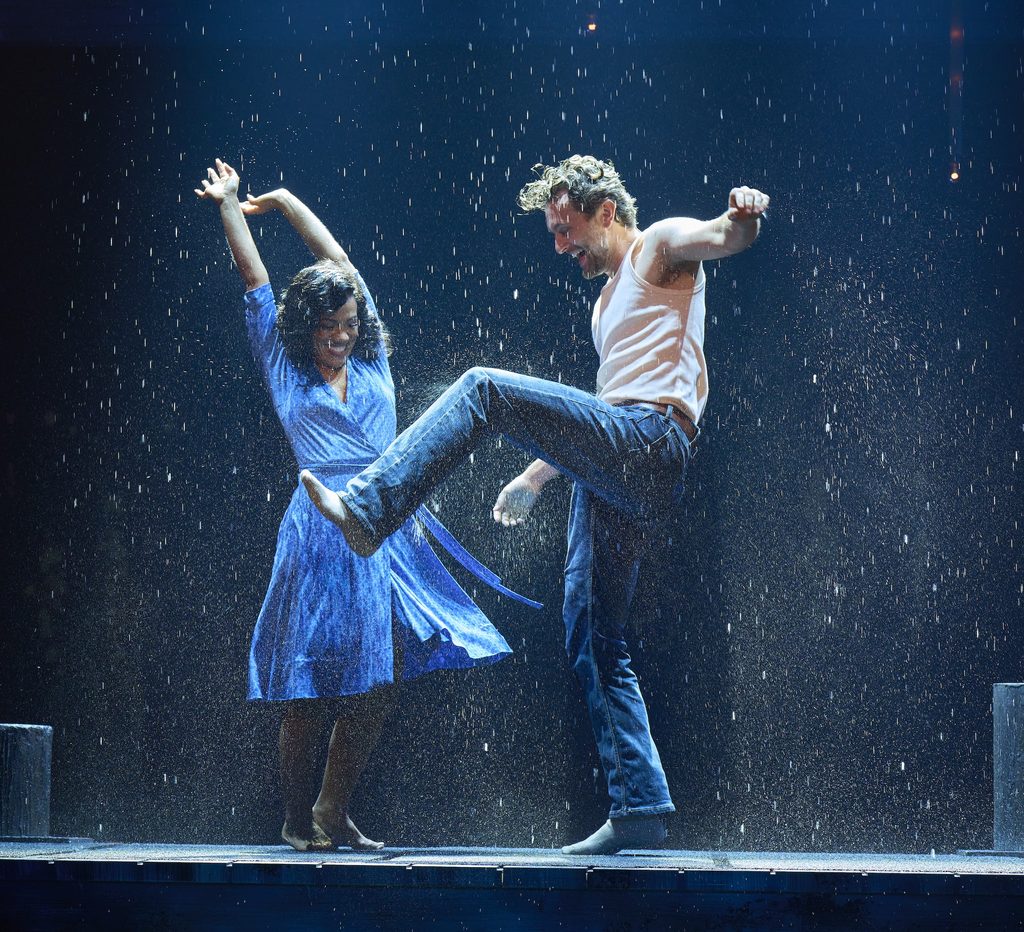
The night’s most striking moment was the iconic rain kiss scene. It employed real water, which is always an impressive feat. However, Noah’s beloved “it wasn’t over … it still isn’t over” quote was curiously absent from the script. It should have been a no-brainer to include this line the audience was almost certainly waiting for (I know I was).
Birchett, as elderly Allie, meticulously portrayed a woman in the middle stages of Alzheimer’s disease. Her performance was alive in the details, down to the restless hand fidgeting that continued even when the spotlight moved elsewhere for an extended period of time.
The production itself also seemed to internalize the disease as a structural principle. Rather than unfolding chronologically, the narrative drifted between distant teenager past, adult past and elderly present in the fractured, non-linear way memory behaves in an Alzheimer’s patient. The audience were fellow travelers inside the disorientation of someone else’s slipping timeline.
Whereas Hollywood typically defaults to white characters for this kind of love story, this production deliberately and refreshingly cast half the characters as Black. There were interracial parents (a Black father, a white mother) to the central interracial couple and their biracial children and grandchildren. The production also quietly subverted convention by making the white male lead be the one without means, while the biracial female lead had both wealth and agency.
Equally striking was how the production used hair (designed by Mia Neal) as a visual language for identity. Young Allie proudly wore her natural hair freely and unabashedly trusted her true self. As an adult bending to the weight of expectation, she straightened her hair into conformity. Then, in the iconic rain scene, she was soaked, raw and finally honest about what she wanted as her hair loosened back into its natural curl.
Scriptwriter Bekah Brunstetter was concerned that “The Notebook” wouldn’t translate to the stage as effectively as the screen; however, after hearing Ingrid Michaelson’s music and lyrics, she was all in. Michaelson’s songs (such as “Dance with Me,” “Leave the Light On,” “I Wanna Go Back,” “If This Is Love” and “Home”) truly capture the moving, touching story of Noah and Allie, inspiring emotions powerful enough to fill the theater with tears.
One aspect that this production could improve upon is the individual vocal performances. While the harmonious blend of voices during the finale is truly impressive, there are moments when some of the cast members appear to struggle with pitch during their solo performances. Their individual songs sometimes come across as slightly off key. With a bit more focus on honing their individual singing skills, the production’s musical quality could be elevated significantly. Still, the show is outstanding. It tugs at your heart and reminds you of what true love can be, even if it’s read from a notebook.
“The Notebook”
- Through Sunday, Nov. 1
- 7:30 p.m. Wednesday-Saturday
- 2 p.m. Saturday
- 1 and 6:30 p.m. Sunday
- Wharton Center Cobb Great Hall
- 750 E. Shaw Lane, East Lansing
- (517) 432-2000
- whartoncenter.com