Dr. Professor Leonard King brings Detroit energy to MSU jazz studies
Too few folks outside of Detroit have drunk from the well of musical joy, virtuosity and wisdom that is Dr. Professor Leonard King.
King is unlike any other guest artist Michigan State University’s jazz studies program has hosted. He’s a consummate drummer, a genre-defying composer, a proud ambassador of his hometown and a keen historian of music, politics and culture.
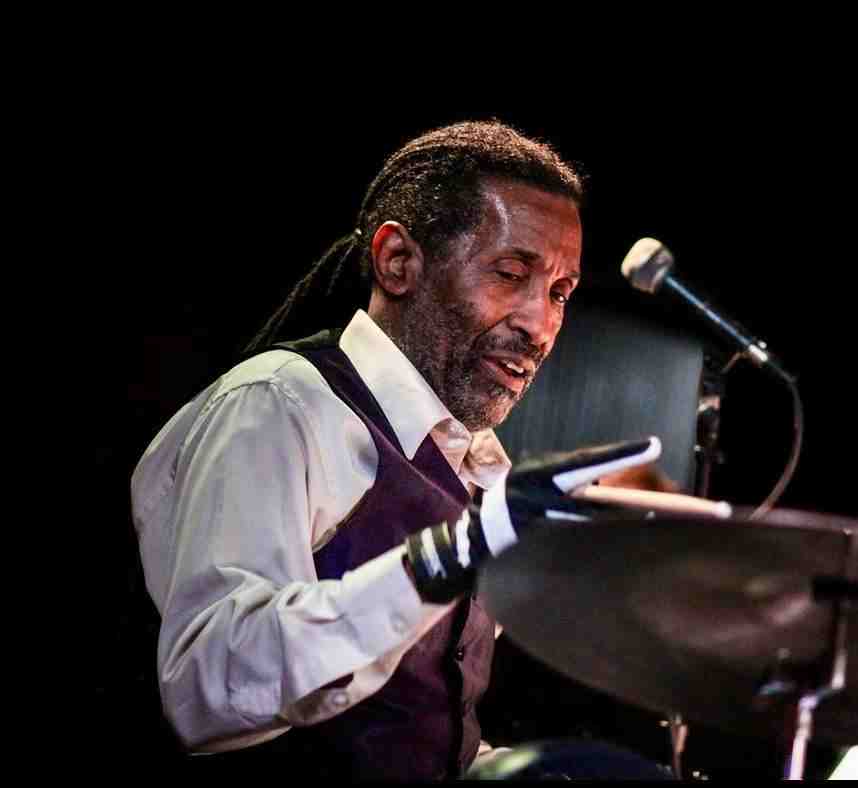
Detroit musical legend Dr. Professor Leonard King is teaching and performing with MSU jazz studies students this week, culminating in a concert Friday with the MSU jazz nonets. Courtesy
Some see him a modern-day, big-city griot, in the tradition of West African musician-storytellers.
He’s wary of being pigeonholed and doesn’t care much for labels like “jazz.”
“In our house, the only rooms that didn’t have recordings were the kitchen and the bathroom,” he said. (It didn’t hurt that his father was in the jukebox business.) “I listened to everything — Charlie Parker, Liberace, Johnny Cash, the Mickey Mouse Club. I was interested in music across the board.”
King is teaching and performing with MSU jazz students all week, culminating in a concert with the jazz nonets Friday at the Fairchild Theatre.
MSU jazz nonets with Dr. Professor Leonard King, drums
- 7:30 p.m. Friday, Nov. 6
- Fairchild Theatre
- 542 Auditorium Road, East Lansing
- (517) 353-5340
- music.msu.edu
He has worked extensively in public schools doing musical outreach, but when it comes to the university level, he brings a non-academic, community-based perspective.
“People ask me, ‘Do you teach?’ Yeah, I teach wherever I’m sitting or standing,” he said. “Here I am, at age 78 — almost 79 — still doing what I set out to do in the first place.”
Since 2010, King has led a powerful, versatile big band, the Dr. Prof. Leonard King Orchestra. The group has enabled his music to blossom in many directions, from jazz to blues to rock, Latin and classical flavors, depending on whatever he is digging at a given time.
A few months ago, he sent a half dozen of his innovative arrangements for the MSU nonets to work on. The titles alone bear witness to his originality and willingness to take risks.
“There’s one called ‘Diaries of Wayward Activities,’” he said, laughing at his own audacity. “It was inspired just by things people do, the contradictions. A calypso seems to come out of nowhere, and from there we go into this funky — I mean real funky — composition that seems like it’s going in a bunch of directions at one time, but it really isn’t.”
He has known MSU jazz studies director Rodney Whitaker, who is also a native of Detroit, for 40 years.
“Rodney was with me when he was 15,” King said. Back then, King was hesitant to call him on a gig because he lived on the southwest side of Detroit and Whitaker lived on the east side, but Whitaker was as diligent then as he is now.
“He had to catch two buses with his double bass to get to me,” King said.
King grew up in a fertile period when music saturated the neighborhoods and schools of Detroit, encompassing everything from bebop to Motown.
“This music was everywhere,” he said. “I’m not just talking about the music called jazz, but especially music that related to Black people — jazz, blues, rhythm and blues, funk, whatever you want to call it. I see the same thread running through all that music. In the ‘50s, ‘60s and ‘70s, you’d have to have your fingers in your ears not to hear it.”
When he was 3, his mother got him a Rudolph the Red-Nosed Reindeer record player.
“It only played 78s,” he said. He still has it.
He was so fascinated that he peered into the grooves, looking for the downbeat from the drums.
“I was trying to figure out where the ‘one’ was,” he said.
He asked his father for a drum kit — a big ask.
“My father could really squeeze a dollar,” he recalled. “So, I only got a snare drum at age 9 and a bass drum the next year. He said, ‘Let’s see what you can do with this first.’ That was important to my development because I learned to do more with less.”
He played his first neighborhood gigs at 12 and became a bandleader at 15, performing at community centers and union halls in Downriver Detroit. His orchestra still plays at some of those community centers.
“It made sense for me to be in the hot seat,” he said. “I was mentored by my father and other elders in the community. In those days, the music had such value that your neighbors would tell you if you weren’t sincere.”
At that time, fashion shows were a lucrative source of income.
“We played early-afternoon lunch socials,” he said. “It wasn’t all nightclubs. I wasn’t old enough to go to a nightclub anyway.”
King played for 35 years with Detroit organist Lyman Woodard, but he’s always made sure to maintain his own groups, giving him an outlet for his expanding tastes and skills as a composer.
Besides the Dr. Prof. Leonard King Orchestra, he leads a group called Oopapada (emphasis on the last syllable), named after a Babs Gonzales song made popular by Dizzy Gillespie, and the Proportioned Orchestra, an unusual ensemble co-founded by Whitaker that features four double basses.
It’s hard not to wonder about the origin of King’s double-dip honorific title, but I withheld the question out of respect.
Fortunately, he offered the backstory without being asked.
As a young man, he was known for persistently asking librarians, teachers and elders in the community for answers to the questions that flooded his mind.
“I like to know the origin of things,” he said. “We know about Z, but I want to know how we got from A to Z.”
By the 1990s, he had gained a reputation for being a walking encyclopedia, and people called him with all kinds of questions.
“Next thing I know, I was being introduced as, ‘Ladies and gentlemen, put your hands together for the one, the only, Dr. Professor Leonard King,’” he said.
He didn’t think of using the title himself at first.
“I didn’t want people thinking, ‘Ah, he ain’t no doctor professor,’” he said.
But his ex-wife told him it perfectly suited him.
“She told me, ‘If somebody asks you about something that happened in 1980, you go back to 1622 and connect all the dots. A question most people would answer in five minutes, you’re still standing there talking a half hour later. So, you are Dr. Professor.’ I said, ‘OK, I got it.’”
The title is not so much a tweak at academia (well, maybe a little bit) as a reminder that there are many paths to learning and wisdom.
“In the world of academia, some people frown on that,” King said. “But people gave that title to me because I’m a community musician. I’ve always been of service to the community where I live and other communities. I realized the people who called me that wanted me to acknowledge that, and it was out of respect to them that I finally understood the value.”