Living in the music: For Yue Bao, conducting is a deep dive, not a power trip
Why do conductors conduct? The popular idea is that it’s some kind of power trip.
Yue Bao, the second of five guest conductors to lead the Lansing Symphony this season, had the same idea when she was growing up in Shanghai, studying piano.
“I never thought for a second that I’d want to be a conductor someday,” she said. “My impression of conductors is that they were bossy, controlling and not nice. I thought there was no way I could be that kind of person.”
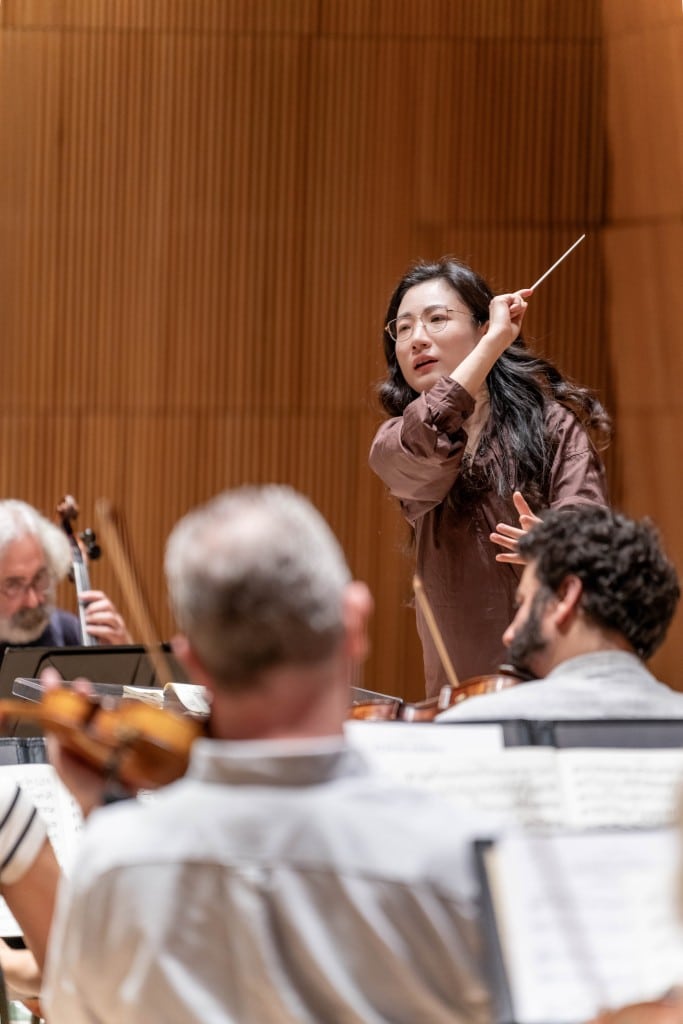
She needn’t have worried. On the podium, Bao exudes a luminous joy and loving attentiveness to every detail. Thrilling to the music of Igor Stravinsky as a young piano student, her first thought was, “How did he do that?” Conducting lets her plunge deep inside the music she loves to orchestrate a transcendent group hug between the composer, the musicians and the audience.
Orchestral music hooked her for good when her piano teacher, who was also a composer, turned her on to the powerful music of Stravinsky and 20th-century juggernaut Dmitri Shostakovich.
“I found the music of Shostakovich brutally honest and authentic,” she said. “It just hit me, affected me deeply and honestly.”
Stravinsky’s intricate, mercurial rhythms and timbres filled her with a desire to learn more.
“I wondered, ‘How did he do that?’ I couldn’t even keep a beat,” she said. She took composing lessons and immersed herself in the craft.
Although Bao hadn’t given a thought to conducting, her teacher was impressed by her ability to swim skillfully in the orchestral ocean and suggested she study it.
If you go: Lansing Symphony Orchestra
Yue Bao, guest conductor
Ying Li, piano
7:30 p.m. Friday, Oct. 16
Wharton Center Cobb Great Hall
750 E. Shaw Lane, East Lansing
(517) 487-5001
lansingsymphony.org
At first, Bao thought only of conducting her own music, but soon the communal highs of conducting began to eclipse the lonely challenge of composing.
“I know it’s an unhealthy way to think about it, but after I learned so many masterpieces and got into the scores, I began to think, ‘There’s no way I can compete with this,’” she said. “I’m never satisfied with my own pieces. Somehow, I felt more comfortable living in the music than creating the music.”
As she learned more about conducting and conductors, her negative impression began to change.
“I learned that it’s more about respect, trust and collaboration,” she said.
After studying at the Shanghai Conservatory of Music, she came to the United States 11 years ago to get her master’s degree at The New School’s Mannes School of Music. She also received an artist diploma as a conducting fellow at Philadelphia’s Curtis Institute of Music.
Her mentor at Curtis was a musical giant, Yannick Nézet-Séguin, currently music director of the Philadelphia Orchestra and New York’s Metropolitan Opera.
“He always knows what he wants, but at the same time, you hear the warmth, the openness, the generosity,” Bao said. “He always told us, ‘Keep a warm heart but a cold mind.’”
Her description of Claudio Abbado, one of her greatest conducting inspirations, reveals a lot about her own approach to conducting.
“It goes beyond conducting. It’s his humanity,” she said. “There’s something honest in his music making. He makes the musicians listen to each other intensely and play like it’s chamber music. When you watch him, you never feel like he’s trying to impress you or show you what a great conductor he is. It’s like he’s genuinely inviting everyone into the music.”
Bao spent three years as an assistant conductor with the Houston Symphony, beginning in late 2019, just before the pandemic lockdowns. Music director Andrés Orozco-Estrada was stuck in Vienna and couldn’t fly back to Houston, so Bao worked with the musicians to keep the music alive, developing one of the first livestream concert programs in the nation.
“It was a hard time, but it made me grow closer to the musicians,” she said.
Bao also worked with retired Lansing Symphony maestro Timothy Muffitt for two months at New York’s Chautauqua Institution.
“It was a very important and memorable experience for me,” she said. “As we all know, he’s an incredibly generous and kind person. It’s all about the music. He gave me so much practical advice.”
Bao is impressed with the many musical tentacles of the Lansing Symphony and hopes to expand its audience even further.
“I’ve seen all the wonderful things they’ve already been doing successfully, like family concerts, composers in residence, the new music series at The Robin Theatre and collaborations with local groups,” she said. “The one with All of the Above Hip Hop Academy really caught my eye.”
At the Minnesota Orchestra in 2022, Bao led a crowd-pleasing rendition of Beethoven’s punchy “Grosse Fuge” with killer breaking (aka “breakdancing”) by BRKFST Dance Co.
“The fans of the dancers brought such a different energy to the concert hall, and it was really exciting,” she said. “I know there are some wonderful dance organizations in the Lansing area, and this is something I would like to explore further.”
She would also like to find ways to bring audiences closer to the orchestra.
“That way, you can really hear how the conductor and the musicians communicate, how we actually put everything together,” she said.
Friday’s concert starts with “Threads,” a playful and vibrant work by Grammy-nominated Michigan State University composer Zhou Tian.
“He’s an old friend, part of the local community, and I think it’s meaningful to open a concert with a composer from home,” Bao said.
The centerpiece is a perennial crowd pleaser, Tchaikovsky’s flamboyantly emotional First Piano Concerto, with award-winning Chinese pianist Ying Li as soloist.
The evening will close with Antonin Dvorak’s deeply personal Seventh Symphony, written shortly after the composer’s mother died.
“We don’t play this symphony too often,” Bao said. “We often associate Dvorak with folk songs, beautiful melodies, but I believe the Seventh reveals another side of him. There’s darkness and urgency, and it’s incredibly dramatic. It feels like he’s inviting us into his inner world, all the struggles and sadness he had, but it’s balanced by lyrical beauty and leads up to a hard-won victory.”
To balance the tumult and stress of the orchestral world, Bao turns to solitude and quietude. During COVID lockdowns, she took up acrylic and oil painting, relying mostly on YouTube tutorials.
“I enjoy watching Bob Ross,” she said, breaking into ringing laughter. “I don’t know, it’s his voice or something. He makes everything look so effortless, but when you try to do it, it’s so hard. You want to learn, ‘How did he do that?’”
No doubt she’ll get there. Years ago, she asked the same question about Stravinsky, and you see where that went.