Rich veins and raw nerves: ‘Cursed Objects’ hold sway at (SCENE) Metrospace
People play fast and loose with the idea of a curse. That parking space where you got seven tickets, that coffee maker that keeps spilling coffee onto the counter, are laughed off as “cursed.”
But the laughter is always a little bit nervous.
“Cursed Objects,” a thought-provoking multimedia art exhibit at East Lansing’s (SCENE) Metrospace, confirms our sneaking suspicions that curses are real, and they carry a mean sting.
Artist and MSU graduate student Hailey Becker tapped into a rich vein, and a raw nerve, when she asked a nationwide pool of artists, “What does it mean for something to be cursed in 2026?”
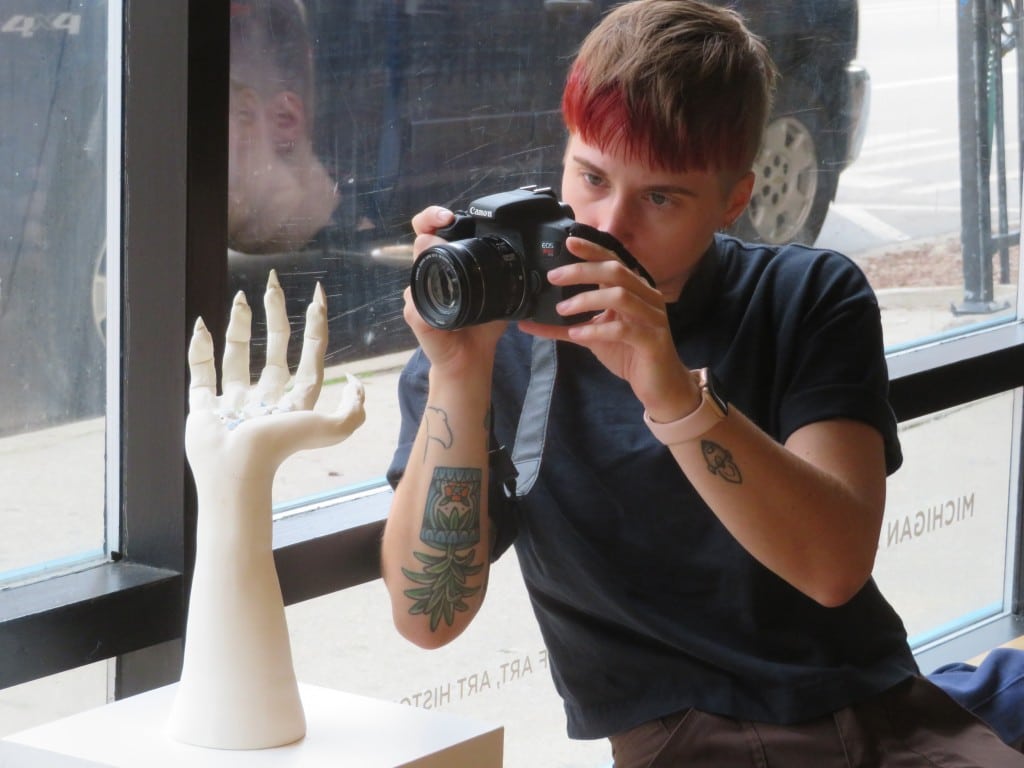
The first thing you see in the front window is Dana Rothe’s claw-like ceramic hand, thrusting from the depths, with a pile of pills in the palm.
Rothe lives with Ehlers-Danlos syndrome, a connective tissue disorder. She is one of several artists in the exhibit who invoke the curse of chronic illness.
Working with clay, a substance that is flexible and strong yet susceptible to breaking, is a way for her to come to terms with the limitations of her own flesh.
The ceramic hand also holds a message that applies to the entire exhibit. A curse, whoever or whatever inflicts it, is something that takes control of your life. The challenge is to claw it back.
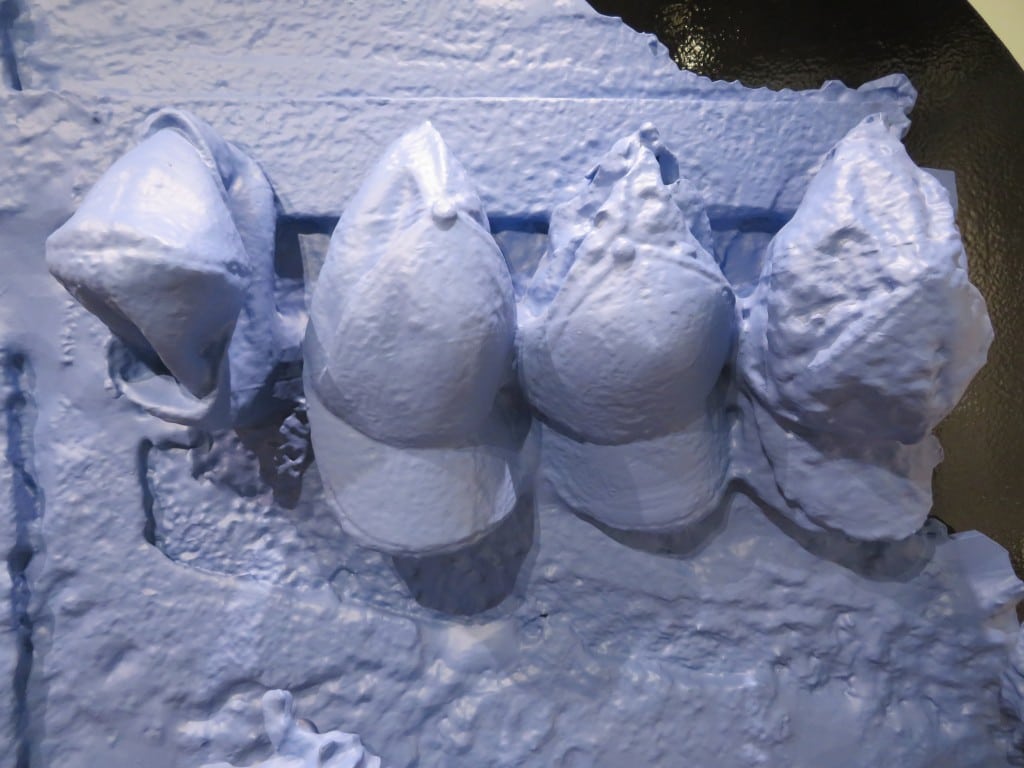
One of the most haunting works in the show is Jason J. Ferguson’s life-sized, 3-D-printed sculpture, made from ordinary photographs of the artist’s home, taken amidst the fear and confinement of COVID lockdowns. Pale blue ghost forms of hats hanging on a rack preserve, and even sanctify, domestic life, like the ashen shrouds left in the houses of buried Pompeii.
Some of the “cursed objects” are just plain creepy.
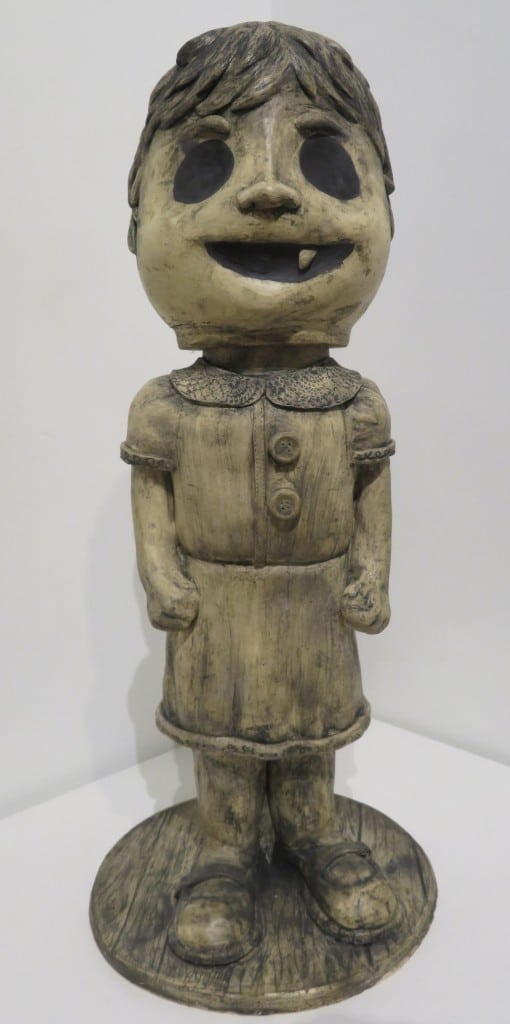
Ceramic artist Lucky Fortunata’s one-toothed, abyss-eyed “Matilda” looks like a lawn ornament for a zombie weed garden.
“Cursed Objects” was conceived and juried by artist Hailey Becker, a doctoral candidate in art at MSU.
Last week, Becker stopped in to (SCENE) Metrospace to see the finished show for the first time and take photos of the art.
“I was very, very pleased with the variety,” Becker said.
As if to enhance the mood of the exhibit, the gigantic building next door to the gallery, formerly home to the Student Book Store, was in the throes of a spectacular demolition.
The pounding and crunching of the bulldozers and the chaotic hellscape just outside the gallery door suited her just fine.
“It’s so great,” Becker said. “It’s in line with the show.”
“Cursed Objects”
Through Oct. 18
Closing Reception 5-7 p.m. Oct. 16
(SCENE) Metrospace
110 Charles St., East Lansing
Gallery open noon-5 p.m. Thursday-Sunday
Becker has a master’s degree in studio art, but is also working on a Ph.D. in forestry.
Becker loves to find meaningful ways to combine her two disciplines. The idea of curating an exhibit on “cursed objects” came into focus when she created “Where the Light Gets In,” a series of light installations calling attention to wooded areas on the MSU campus slated to be gobbled up by the proposed Spartan Gateway development along Harrison Road. She’s currently helping the city of East Lansing develop its Tree Canopy Revitalization Plan, and has even hosted community focus groups at (SCENE) Metrospace.
“For me, the idea of a curse comes from the environment, and for me, that means the land,” she said. “I thought, ‘Is this land cursed?’ It’s not a protected green space, like the north part of campus, and it’s destined to be developed on.”
She wanted the “cursed objects” exhibit to encompass various ways land, people, objects or anything else can fall under a curse.
“I was thinking about cursed landscapes, but I didn’t want to limit it,” she said. “I wanted to see what other artists were thinking about.”
The result is a mix of art by local artists, MSU students and professors and artists from New York, San Francisco and around the country.
Becker was given a limit of 25 works by Laurén Gerig, director of galleries and outreach in the MSU Art Department and manager of the gallery.
“It was very difficult,” Becker said. “We had to cut a lot of very good works.”
What surprised and pleased her most was the number of artists who mustered the will, and the creative means, to ward off a curse and regain control of their lives.
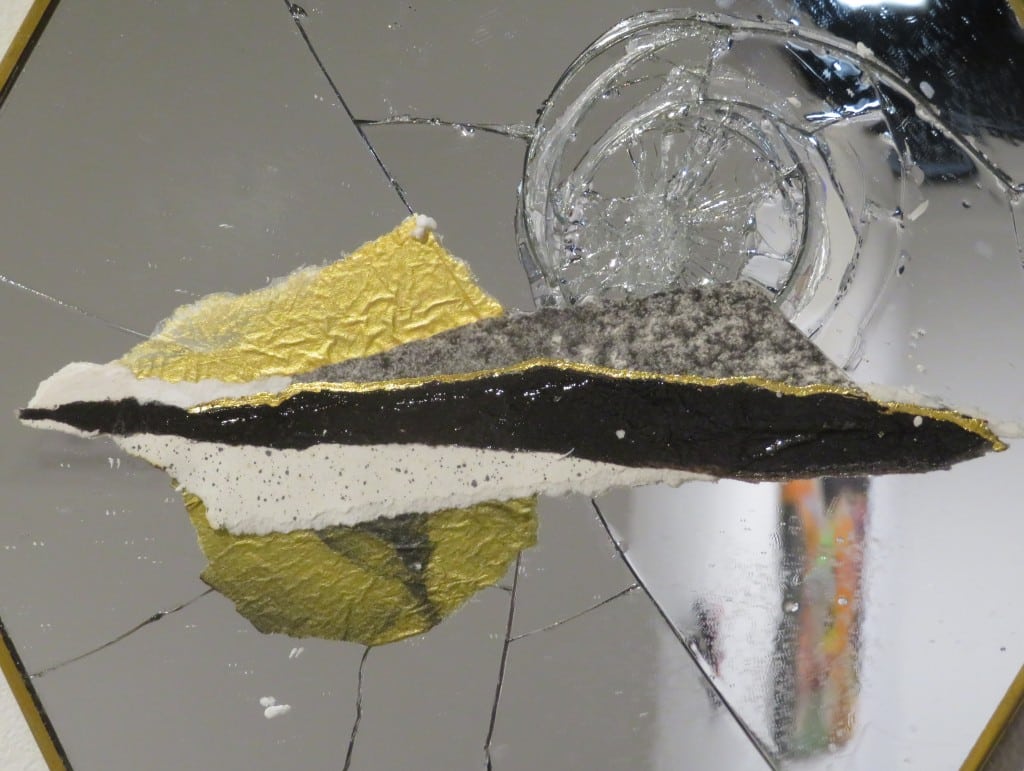
Allison Belolan turned a potential curse into creative gold by breaking a mirror and working the resulting web of cracks into a fantasia of gold leaf and other materials. Photo by Lawrence Cosentino/City Pulse
“There’s a lot of action going on in the pieces,” Becker said. “People were not accepting some of the curses put on them anymore.”
Artist Allison Belolan courted the proverbial seven years of bad luck by deliberately breaking a mirror, but fought off the curse by reassembling the shards and decorating the resulting web of cracks with gold leaf and other materials.
When it comes to lifting curses, William Ross decided to go as big as possible. His multi-phase installation “Trump Toxic Legacy Disposal” invites the viewer to shred bits of Donald Trump’s legacy, one by one, the way Elon Musk cruelly threw the life-saving U.S. Agency for International Development into the shredder in 2025.
Skeptics may roll their eyes at the spitball futility of activist art. Nevertheless, firing up Ross’s contraption and uttering one of his recommended incantations (“I shun this thing,” “This is repulsive to me”) sparks a buzz in the gut that feels connected to a bigger, unseen power grid. Art reveals possibilities.
“People are willing to take hold of their curses and regain agency,” Becker said. “I think that’s very reflective of what’s going on politically, in the world today.”