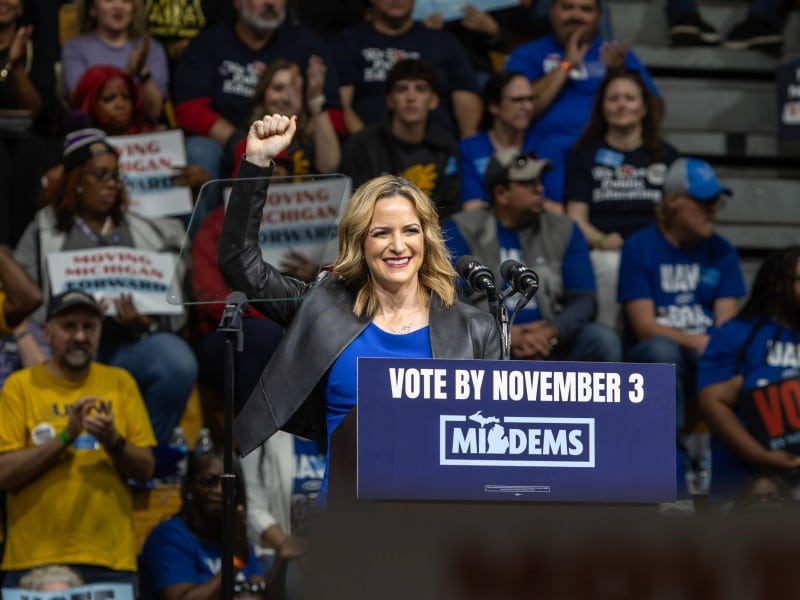
Abdul El-Sayed declares victory in U.S. Senate race against Mike Rogers
DETROIT — The progressive wave sweeping the nation reached its crest in Michigan early Wednesday as Abdul El-Sayed, the Democratic U.S. Senate nominee, declared victory Republican former U.S. Rep. Mike Rogers.
“We just showed them that a movement of the people, by the people, and for the people will ultimately win,” El-Sayed told supporters gathered in Detroit. “They tried to confuse you. So let me just set the record this straight. I love America. I know exactly what America gave to me. Michiganders believe in Michigan, and I believe in Michiganders, and I am so honored that Michiganders believed in me.”
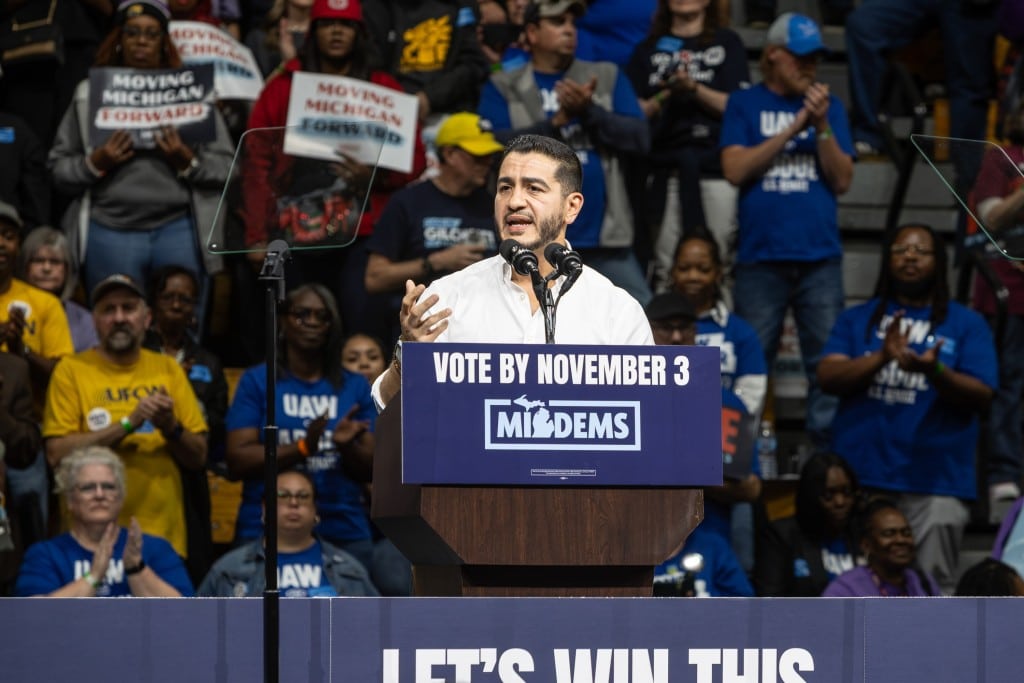
Unofficial results reported by the Associated Press show that with 80% of the vote counted, El-Sayed was leading Rogers 51.8% to 46.2% as of 1:50 a.m. The AP, however, had yet to officially call the race.
If confirmed, El-Sayed’s election would be historic: He would become the first Muslim U.S. senator when he takes office in January.
El-Sayed will succeed retiring U.S. Sen. Gary Peters (D-Bloomfield Township). It would also be the second loss in as many years for Rogers, who also lost in 2024 to now-U.S. Sen. Elissa Slotkin.
This is a developing story, read more here
As a progressive closely associated with U.S. Rep. Alexandria Ocasio-Cortez (D-New York) and U.S. Sen. Bernie Sanders (I-Vermont), El-Sayed will bring to Washington a focus on expanding the Affordable Care Act into a Medicare for All system, ending the war in Iran and renegotiating the U.S. relationship with Israel.
Throughout his political career, including the 2026 U.S. Senate campaign, El-Sayed has accused Israel of committing genocide against Palestinians during its war with Hamas in Gaza. While that determination remains controversial, it is supported by multiple international organizations including Amnesty International, Doctors Without Borders and a United Nations commission.
His victory comes in spite of the GOP narrative that Democratic Jewish voters were divided over El-Sayed as seen in polling conducted on behalf of The Jewish Majority, in which he “significantly underperformed Jocelyn Benson among Jewish early voters, receiving just 57% of the vote compared with 78% for Benson, a gap of more than 21 percentage points.”
Additionally, the polling, which was conducted October 25–31 among 482 Michigan Jewish early voters, said 99% of self-identified Jewish Democrats who did not vote for El-Sayed said they would have been likely to support a different Democratic nominee.
El-Sayed’s appeal was also broader than just his opinions about Israel, as many voters were also weighing issues such as the rising cost of living, the economy and opposition to President Donald Trump’s agenda as they decided who should represent Michigan in the Senate.
“I voted for Abdul El-Sayed because he’s focused on the issues and not a bunch of bigotry and racism,” Katie Page, 49, of Rochester said on Tuesday. “I think he’s going to fight for us because we’ve already seen him fight for the people of Detroit.”
Page said she is mainly concerned with opposing Trump’s agenda, flipping the U.S. Senate and getting money out of politics
“I am hoping we can … take the country back from essentially the oligarchs and nonstop corruption,” she said.
Although El-Sayed has fashioned himself as a capitalist concerned with ending corporate greed and allocation of wealth to the top 1% of earners, several of his campaign policies have been espoused or championed by democratic socialists. El-Sayed is not a member of the Democratic Socialists of America, but two of his closest allies, Ocasio-Cortez and U.S. Rep. Rashida Tlaib (D-Detroit), are associated with the organization and have praised his platform.
Working with Sanders in the Senate and Ocasio-Cortez in the House, El-Sayed aims to bring structural change to current U.S. policy if he can convince his fellow Democrats in the political center aisle to go further left.
The extent of that influence remains to be seen, but El-Sayed’s six-year Senate term could push Democrats toward policies many of their voters have advocated, particularly in Michigan.
This is a developing story and will be updated as more information becomes available.