From wall to shining wall, ‘We Are This Land’ waves many flags at MSU Broad Art Museum
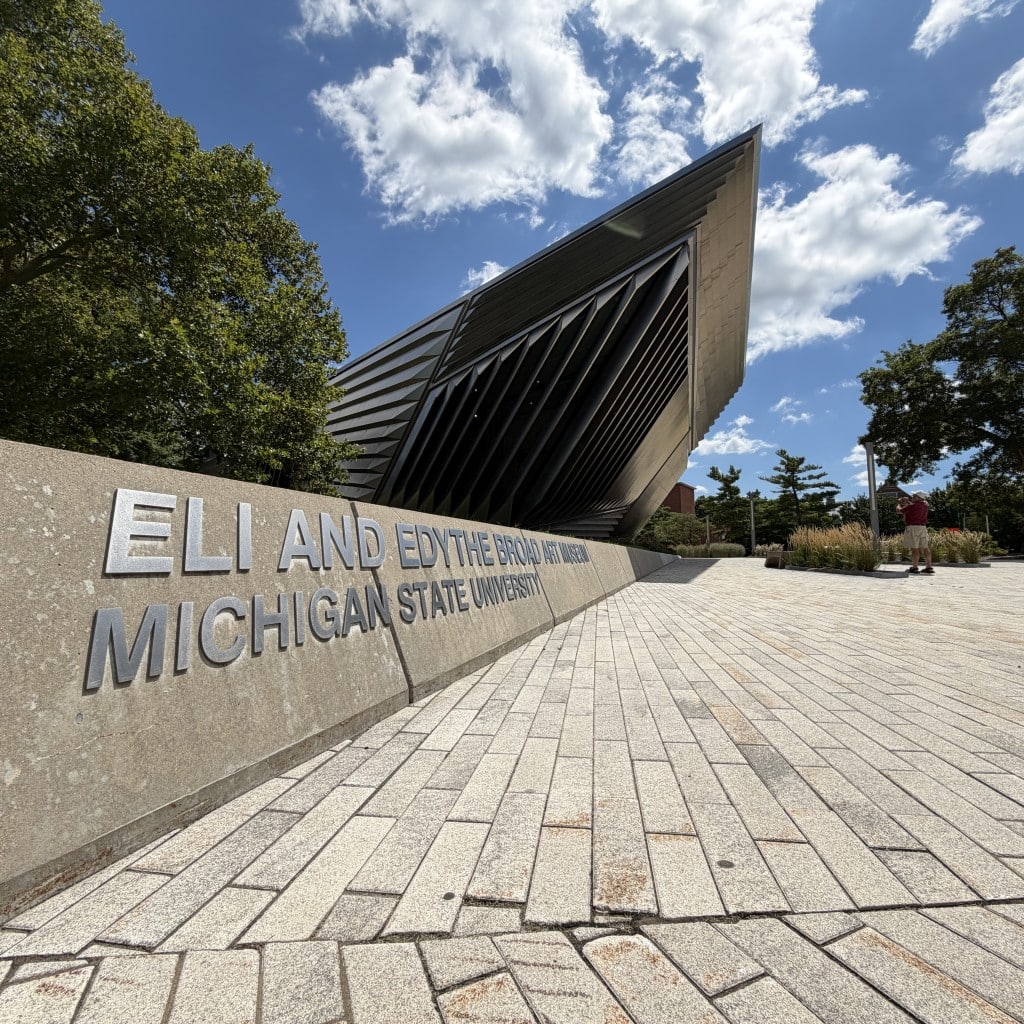
It’s tempting to resort to vaguely uplifting platitudes to describe “We Are This Land,” the MSU Broad Museum’s ambitious, museum-wide exhibit marking the 250th birthday of the United States, on view through March 14, 2027.
But that would miss the point. This exhibit avoids platitudes like the plague.
If you’re bracing for another harangue on how great America is, or was, or how it needs to be great again, or it never was great in the first place, forget it. This exhibit, like its subject, is an open-ended, complicated, diverse, flawed, beautiful and deeply human endeavor.
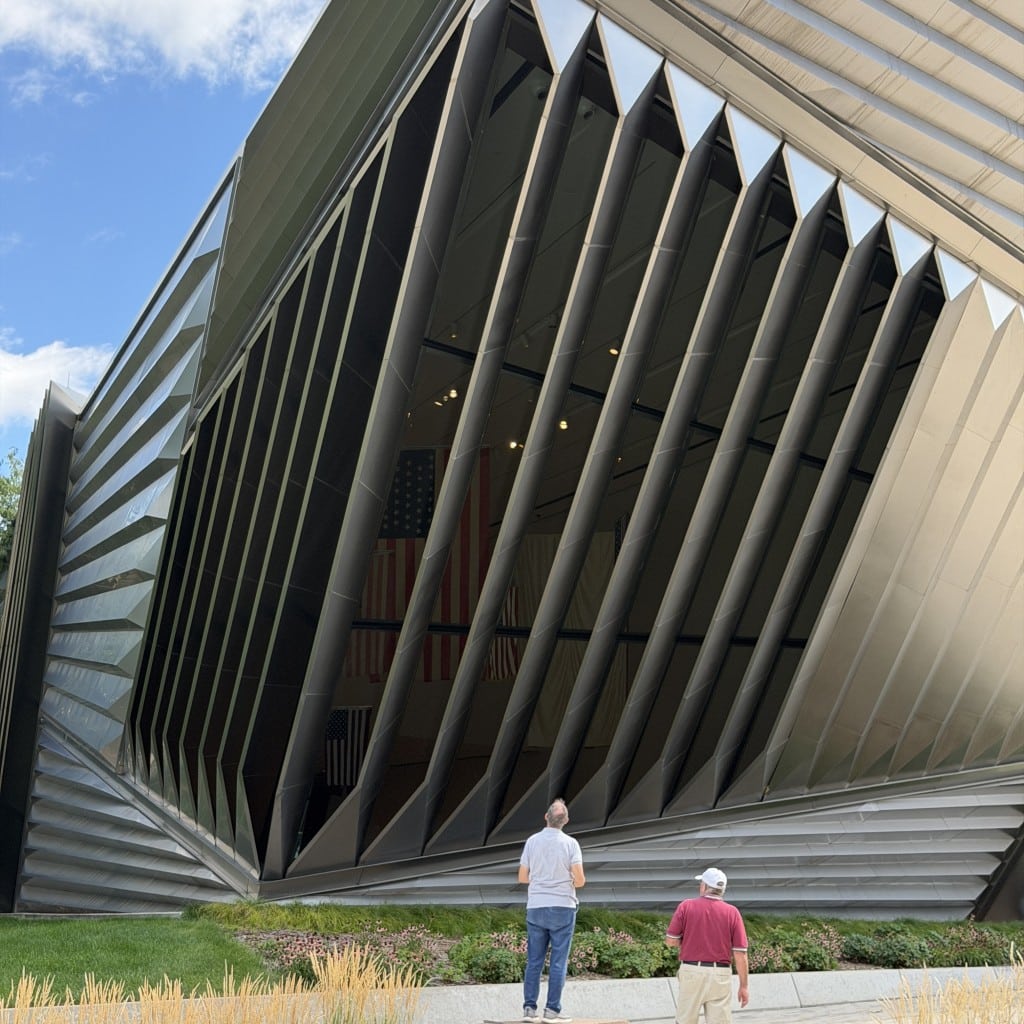
Mike Ellis/City Pulse
Drawing on the Broad’s own historic collection of art, newly commissioned works, historical nuggets from the MSU Museum, libraries and other campus resources, “We Are This Land” lays out a lavish banquet of stimuli no formula or agenda can summarize.
The exhibit brings together hundreds of stunning prints, lush oil paintings, thought-provoking sculptures, video art, maps, flags, everyday objects and unique works that cross genres and mix media. Just to keep you on your toes, there’s a sideways teepee and a backwards map.
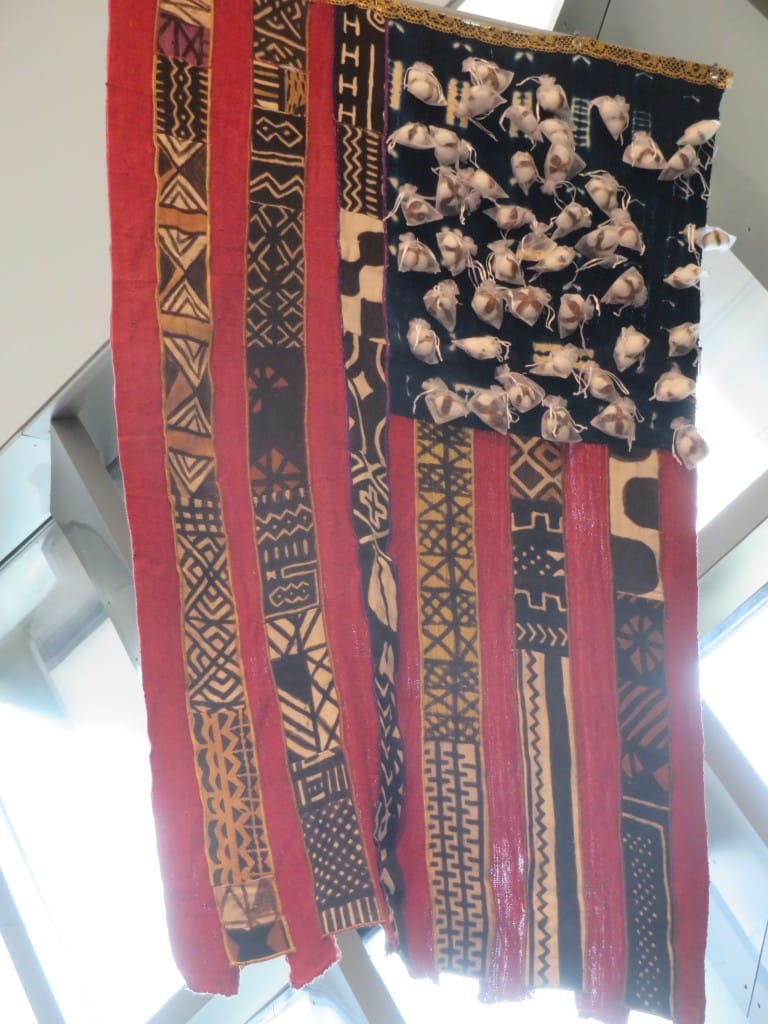
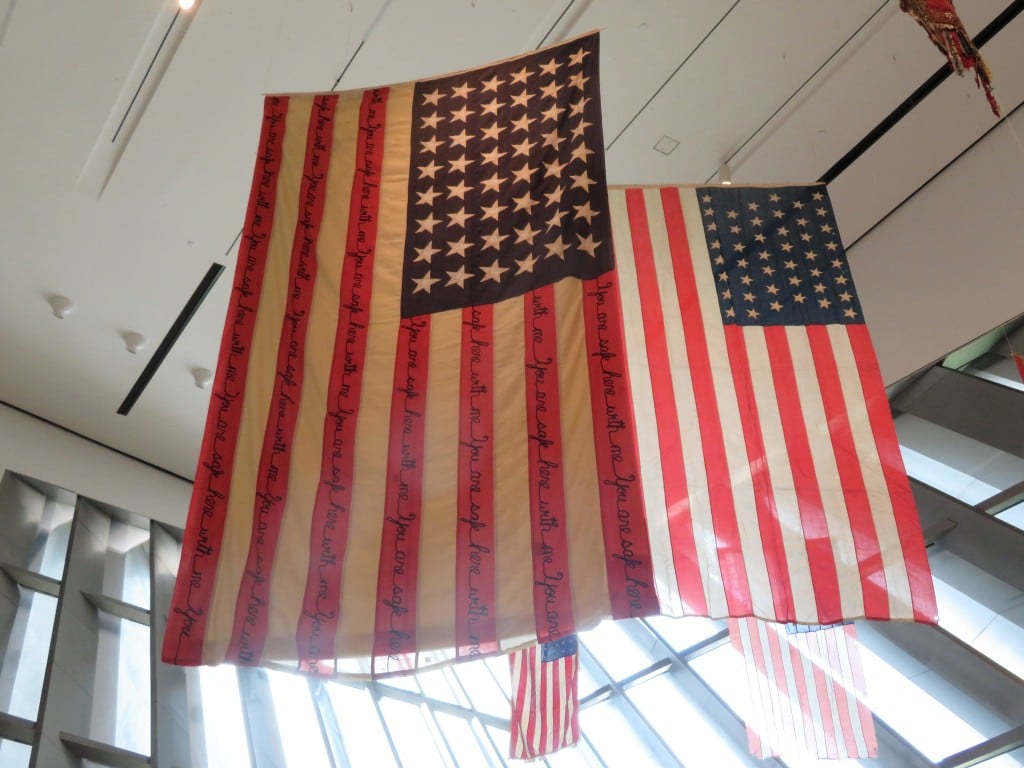
Everywhere you look, art and history bounce off each other, beginning with a luminous array of flags in the airy main gallery, where a historic U.S. flag with 44 stars, dating from the 1890s, flies next to hand-crafted art flags by Chicago-based artist Candace Hunter and New York-based, Iranian-born artist Sara Rahbar.
Lawrence Cosentino/City Pulse
One of Rahbar’s two flags is embroidered with the repeated message, “you are safe here with me.” Her other flag is made of fabric her father brought from Iran.
The mutually illuminating interplay of historical artifacts and fine art runs through the entire exhibit.
“These flags are about the promises implied in the flag, but they also draw on her family story, coming from Iran to the United States,” Broad Museum assistant curator Rachel Winter said. The Hunter flag re-interprets the traditional design with bands of red, geometric patterns and tufts of cotton in lieu of stars. The flags are also gorgeous to behold as they filter the light streaming through the museum’s enormous west window.
Lawrence Cosentino/City Pulse
For Broad Museum senior curator Steven Bridges, the flags bear witness to an ongoing story.
“We’ve only had a 50-star flag since 1960,” he said. “If we were to add a state, or lose a state in the future, it would change again. The story is not finished; it’s not written in stone. It drives home this point about the unfixed nature of all of these ideas, these stories, these experiences. It’s being written today and will continue to be written.”
The great experiment
Bridges and his staff started planning “We Are This Land” four years ago. At that time, Phillip Bahar had not yet been selected as the museum’s director and Bridges was serving as interim director.
“We saw this anniversary coming, and wanted to acknowledge it in some significant way, but at that point it was open-ended as to what that would mean and what it would look like,” Bridges said.
“We Are This Land: Meditations on the Great American Experiment”
MSU Broad Art Museum
Aug. 22, 2026-March 14, 2027
MSU Broad Art Museum Fall Opening Party
6-10 p.m. Friday, Sept. 18
Register for free at broadmuseum.msu.edu/events
He knew that in order to devote the entire museum to a single exhibit on the multifarious American experience, he would need all hands on deck, so he enlisted the entire Broad curatorial team, along with the education, communications and support staff.
The key to getting a handle on such a huge subject was hiding in plain sight.
It may not be obvious at a casual glance, but there is a deep affinity between the MSU Broad’s role, as a showcase for contemporary art and cutting-edge ideas, and the origin and history of the United States. The affinity is so simple it can be expressed in a single word: experimentation.
“This democratic endeavor was an experiment,” Bridges said. “George Washington makes reference to that.”
Bridges and his staff kept that in mind as they fleshed out the exhibit’s component parts, and added two more “foundational ideals” — participation and representation.
“Participation — being involved, engaged, voting — is crucial to democracy,” Bridges said. “Representation is made visible through the art in the exhibition. All three ideals are foundational to the country, and they inspired this show.”
The curators began to hunt down and acquire new works of art “with this moment in mind,” Bridges said. The staff took the exhibit’s title from “Bless This Land,” a 2019 poem by former US poet laureate and indigenous activist Joy Harjo.
Lawrence Cosentino/City Pulse
Looking for a physical element that would weave the sprawling exhibit together, the staff hit upon the perfect artist. In 2022, Winter was touring museums in New York when she came upon an intriguing 2022 work by Lebanese-American artist Rayanne Tabet, “100 Civics Questions.” Tabet’s installation blended real questions from the study guide to the U.S. Citizenship Exam into the architecture of the Whitney Museum of American Art. At the Broad, questions from the study guide are inscribed in the same sans-serif font used for labels and directional signs, leaving the unsettling impression that the building itself is testing you on your knowledge of U.S. history and civics.
There are 20 questions from the study guide scattered in “often unlikely spaces” at the Broad.
“They sort of blend in yet stand out,” Winter said.
The name of Tabet’s installation was updated to “128 Civics Questions,” because the study guide was revised in 2025 with 128 instead of 100 questions.
The project was inspired by Tabet’s own experience studying for the citizenship exam.
“His thought was that if you read the questions in a stairwell or similar place, outside of the context of a study guide, it invites us to think harder about what we know,” Winter said.
Mike Ellis/City Pulse
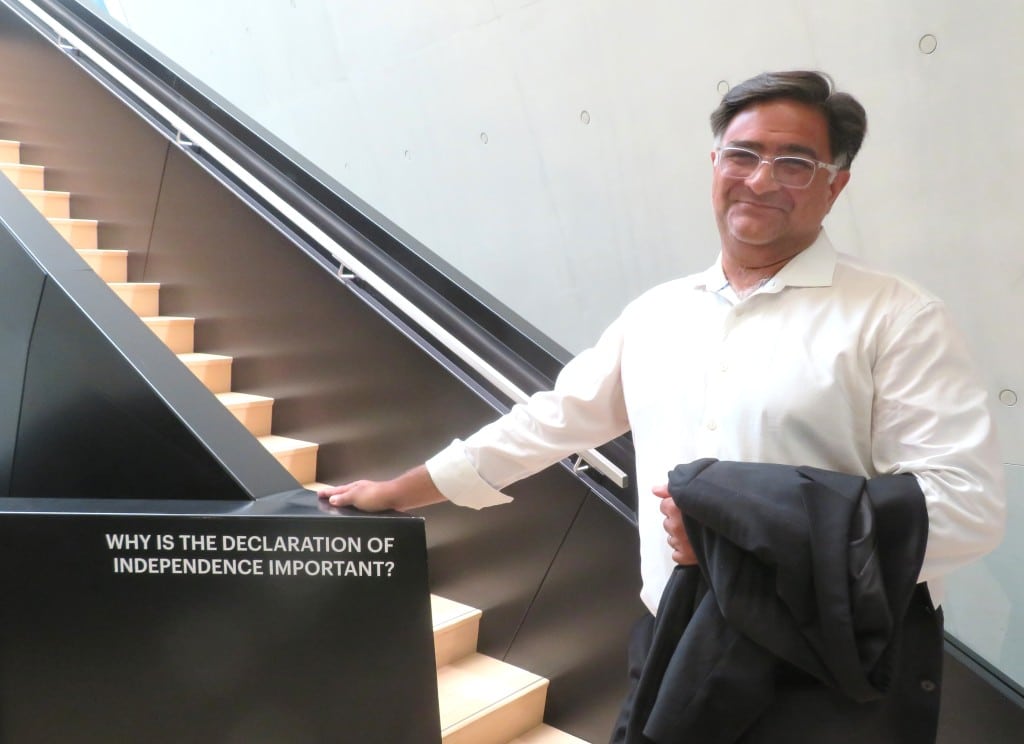
As Broad Museum Director Phillip Bahar walked through the museum last week to see how the exhibit was coming along, he stopped to read a question in the stairwell: “Why is the Declaration of Independence important?”
“It forces all of us to think about what we actually know about our own history,” Bahar said. “You ask people who want to be citizens all these questions and I bet most of us couldn’t answer a majority of them.”
The Tabet project took on a life of its own and already stretches beyond the Broad, with location-appropriate questions installed in Beal Gardens, the MSU Museum, the libraries, the Music Building, Communication Arts, the Multicultural Center and the Law College.
New art, historic nuggets
Taking advantage of four years of prep time, the Broad’s curators were able to seed “We Are the Land” with many newly commissioned works of art. Some of them, like a gravity-defying, right-angle-oriented teepee by Canadian artist Duane Linklater, are strikingly ambitious in scope.
The cone-shaped, wooden framework of the sculpture is fastened with bolts to a wall partition, letting the fabric covering drop to the floor.
The stark sculpture evokes a family’s home, and an entire way of life, violently upended and rudely exposed, yet clinging tenaciously to existence.
The Broad acquired the sculpture two years ago, in preparation for this exhibit. “Duane’s work is hard to apply language to,” Bridges said. “It exists almost in a space beyond that, and it makes a strong impression on viewers. It’s a really major work and we were lucky to acquire it.”
Lawrence Cosentino/City Pulse
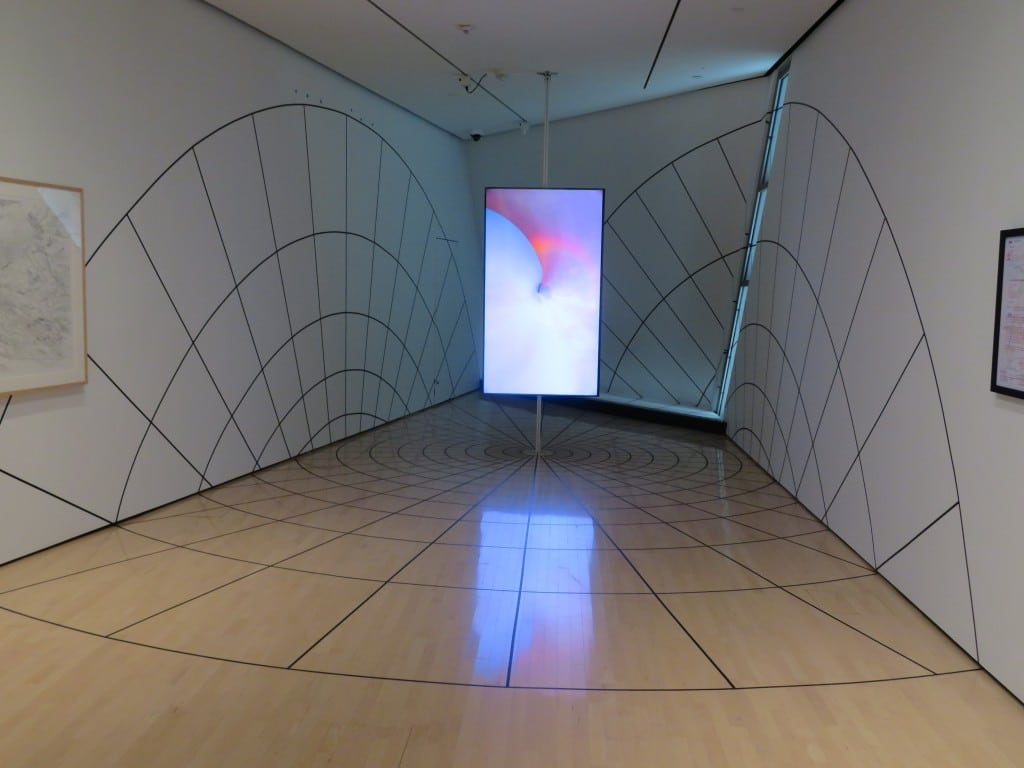
Evan Roth, a Berlin-based artist who was born and raised in Okemos, returned to mid-Michigan to create another brand-new work, the mysterious and beautiful “Skyscapes: East Lansing,” for the Broad. Roth photographed the sky above the museum for a week and processed the images, via software, into two-dimensional map projections. Artfully exploiting a pinched, art-hostile corner of the Broad’s quirky inner galleries, he inscribed lines of latitude and longitude into the alcove surrounding the video, creating a quietly compelling visual vortex.
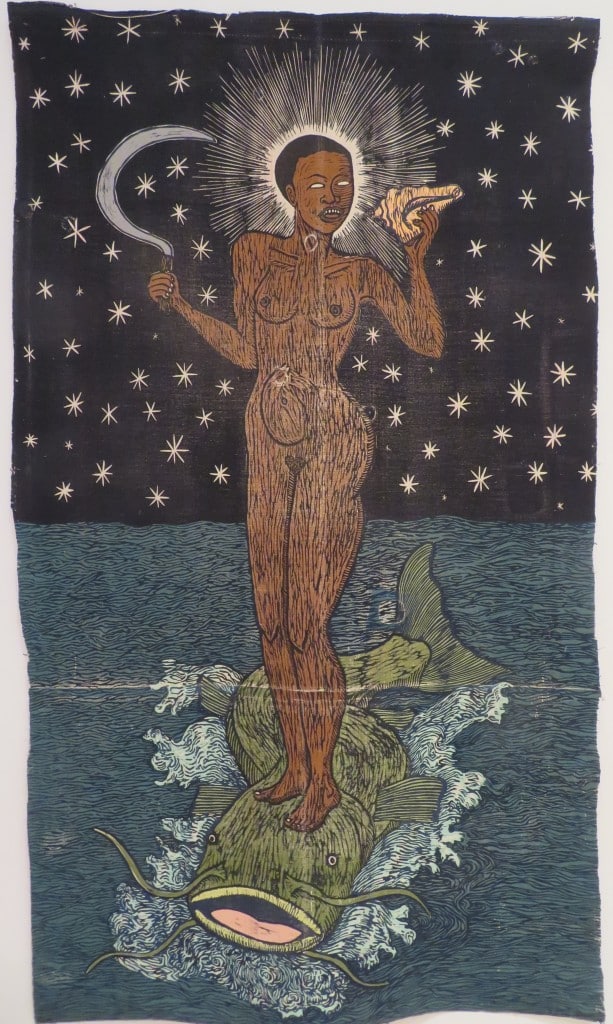
The exhibit’s “history” room includes another spectacular piece acquired by the Broad specifically for this exhibit: “Mutiny of the Sable Venus,” a stunning print, on burlap, by Los Angeles-based artist Alison Saar, depicting a nude Black woman riding a magnificent catfish with a twinkling, starry sky in the background.
The image is a response to “Voyage of the Sable Venus,” a 1793 print by British author and illustrator Thomas Stothart. Saar’s Venus is recast from an enslaved prize to a proud warrior, holding a scythe and a conch shell.
The new works are attention-grabbers, but about 70 percent of “We Are This Land” comes from the Broad’s historic collection, along with campus treasure houses like the MSU Museum, the Map Library, Library Special Collections, University Archives and other local sources.
Lawrence Cosentino/City Pulse
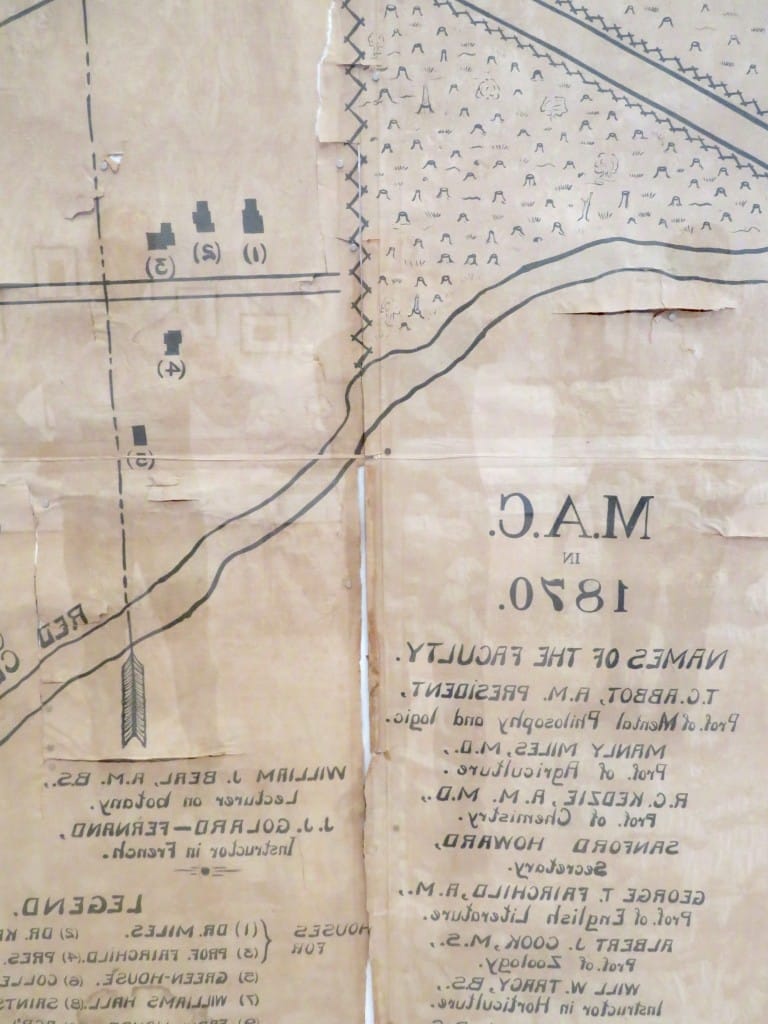
While rummaging through the MSU Museum collection, looking for exhibit material, Bridges was intrigued to find a backwards-printed, hand-lettered map that appeared to depict parts of MSU’s north campus. The map was discovered when workers demolished one of the earliest houses on campus.
“They were taking off the wallpaper that had built up over the years, and this was on the back of it,” Bridges said. The map can’t be shown frontwards, because the front is still stuck to the wallpaper. The 1870s time period coincides with fabled MSU horticulturalist William Beal’s residence in the house, so it’s likely that Beal himself drew the map on the wall, along with a poignant sketch of about 50 stumps where loggers cleared a nearby forest, a list of MSU professors and other information.
The Broad’s unique status as a campus-based museum with multiple troves of cool stuff within walking distance made it the ideal nexus for a mashup of fine art and American history.
“It was fun, interesting and exciting to find out what’s actually here, and, in some cases, unexpected in an art museum context,” Bridges said. “We didn’t need to look far and wide. There is so much to explore right here.”
The exhibit is loosely organized into six subject areas like “civics,” “history” and “family,” with each gallery devoted to one subject, but Bridges and his staff didn’t just divvy up the art and assign each object to “its” room. The museum’s open design, with unexpected sight lines in all directions, encourages ideas to bounce and roll around like a pinball, from space to space.
Some of the juxtapositions are quietly brutal.
Placed provocatively behind Duane Linklater’s sideways teepee is a colorful, panoramic mural entitled “Natural Resources of Northern Michigan,” painted by Carl Frezell in the 1930s for the Bessemer Courthouse in Michigan’s Upper Peninsula.
The mural is crammed with idealized images of farming, logging, mining, hunting and city building in Michigan’s north country. It was created in the heyday of the Works Progress Administration, a federal program established under President Franklin Roosevelt’s New Deal to promote public art and support artists during the Depression.
Lawrence Cosentino/City Pulse
The panorama of seemingly limitless agriculture and industry is impressive, but it looks quite different through the dried ribs of an upturned, empty teepee.
The second-floor “family room” of the exhibit not only focuses on themes related to the family, but looks a bit like an American family room. There is a portrait wall, a coat rack festooned with military uniforms, an MSU marching band jacket, a Boy Scout uniform and other all-American outerwear, a wild set of bookshelves (actually an art installation paying tribute to prominent Americans) and even a sort of home entertainment wall, centered on works of video art with flanked with pieces from the Broad’s historic collection. To facilitate lolling, there are two inviting, manatee-sized bean bag chairs on the floor.
‘A civic act’
Like the American experiment itself, “We Are the Land” is an open-ended, ongoing effort with the potential to go in many different directions. Bridges and the curators have lots of ideas for events and programming that will pop up at the Broad during its six-month run.
Bridges said the museum is moving away from experiences “where you come and listen to someone talk” to doing things that are “more participatory, more experiential,” such as poetry, music, food-oriented events and live performances. The museum-wide Opening Party is already set for Sept. 18, and the museum website and FaceBook page will soon list further events.
Mounting a high-profile art exhibit centered on the American experiment at a charged moment when museums and universities are being pressured to play down the darker aspects of the nation’s history might strike some observers as risky, but Bahar shrugged off the idea.
“It’s really just a civic act, showing our history through art,” Bahar said. “I understand that some people might be taken aback by a flag that’s not the actual flag, but you see the transformation of the flag. It’s constantly evolving. This is a celebration of the variety of voices, the generations that are brought together in these rooms, and it’s pretty remarkable.”
“Museums, including art museums, are often rightfully regarded as civic institutions,” Bridges said. “To me, that means there is a civic responsibility to participate, to feed that curiosity, explore, see something different, and, ideally, to bring people together. That gave us the internal strength and will to proceed with this project over the past few years.”
It may strike skeptics as a leap of faith, but Bridges and Bahar are respecting the Broad’s audience as adults who can handle nuance and conflicting input, if it’s sincerely and honestly presented.
“Throughout this show, you’ll encounter what you might call contradictions,” Bridges said. “If anything, art actually has the power to help us hold two opposing ideas in your head at one time — more than two.”
He’s eager to see how the public responds to the gloriously messy banquet he and his staff have put together.
“Can something be celebratory and moving, but also problematic, at the same time?” Bridges asked. “If you’re able to see something from a different perspective, maybe that might leave some lasting change in the way you re-engage with life outside the museum. For me, that’s one of the most exciting things about this show — seeing how people respond, what they take with them into the world after being here.”
This story has been updated to credit artist Candace Hunter with creating a flag made with colors and patterns inspired by her heritage as an African American woman and substitutes tufts of cotton for the stars.